

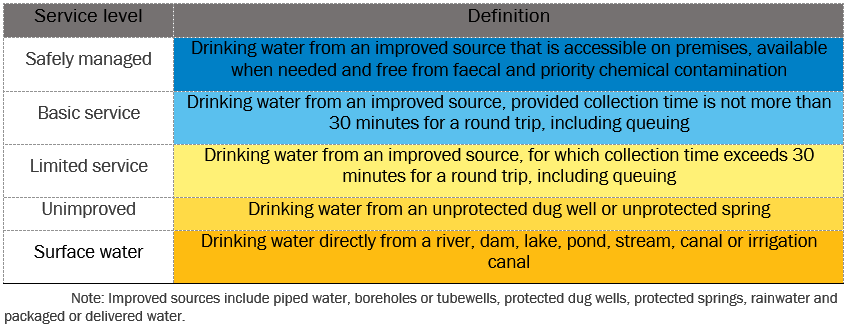
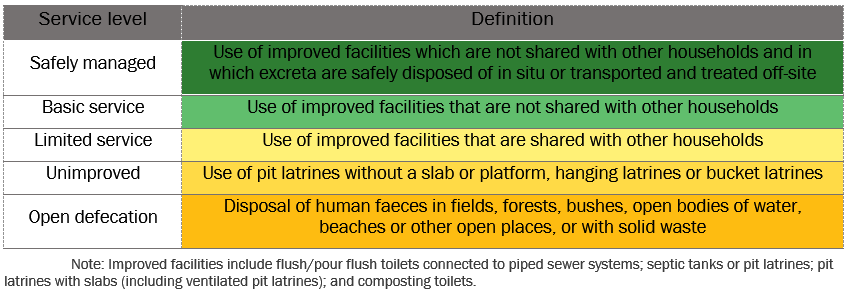
The 2030 Agenda established ambitious global targets to ensure universal access to basic services (target 1.4), including to safe drinking water (target 6.1) and sanitation and hygiene (target 6.2). To produce internationally comparable estimates of progress on drinking water, sanitation and hygiene (WASH), the World Health Organization and United Nations Children’s Fund (WHO/UNICEF) Joint Monitoring Programme for Water Supply, Sanitation and Hygiene (JMP) established standardized service ladders5. The drinking water ladder (Figure 1) defines five levels of service, ranging from ‘surface water’ (no service) to ‘safely managed,’ which is the global indicator for SDG target 6.1. Similarly, the SDG service ladder for sanitation (Figure 2) defines five levels of service, ranging from ‘open defecation’ (no service) to ‘safely managed’ which is the global indicator on sanitation for SDG target 6.2. The focus of global hygiene monitoring is on hand hygiene and the SDG service ladder for hygiene (Figure 3) defines three levels of service ranging from ‘no facility’ to ‘basic’, which is the global indicator on hygiene for SDG target 6.2.
5 For more details, visit https://washdata.org/.

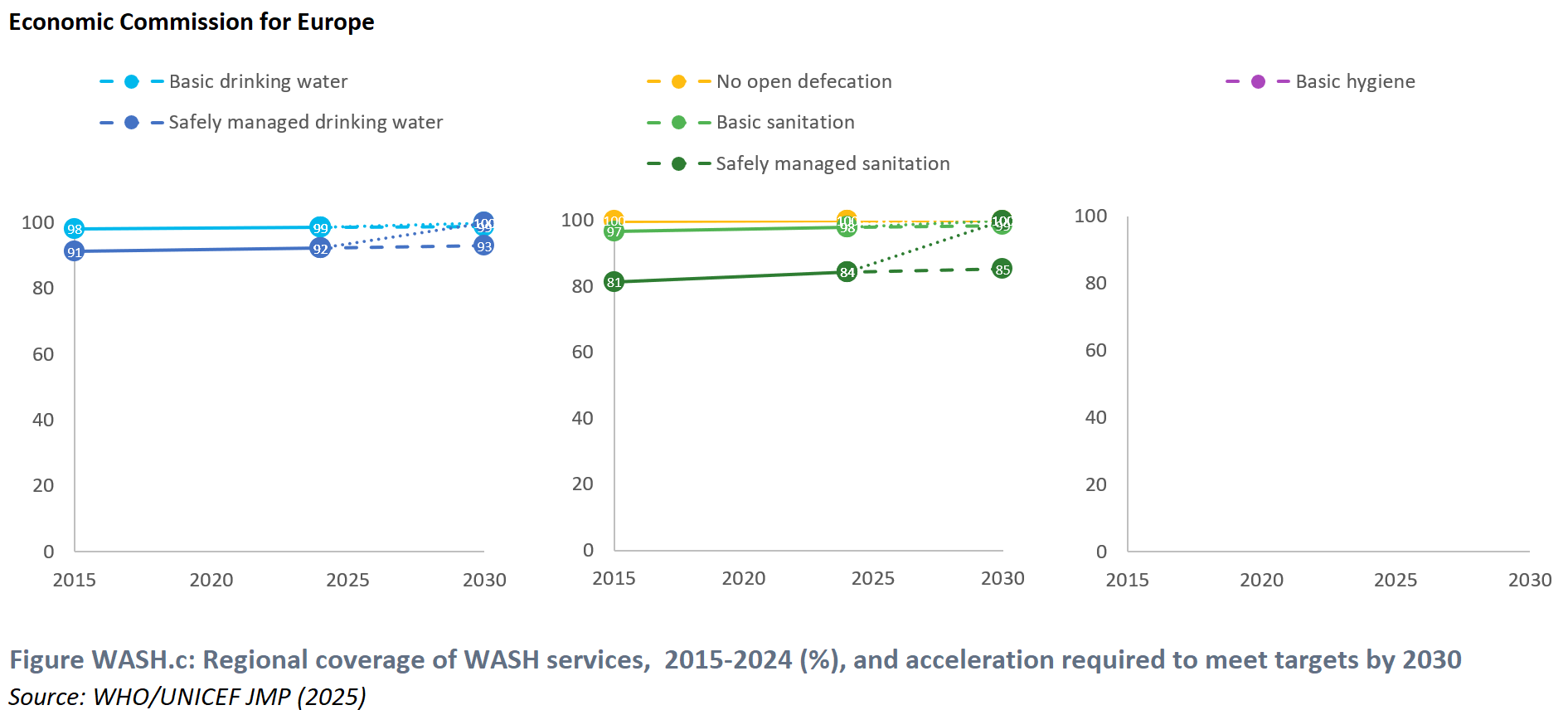
Data for the corresponding global drinking water and sanitation indicators are now available for approximately 50 per cent of the population in the UNECE region, whereas data for hygiene are very limited (covering only 8 per cent of the regiononal population) for assessing progress. Based on these available data, the region is on track to achieve almost universal coverage (>99 per cent) of basic drinking water and basic sanitation services6. The region has also increased coverage of safely managed services, but achieving universal coverage by 2030 will require a 10-fold increase in progress rates for safely managed drinking water (SDG 6.1) and a 17-fold increase for safely managed sanitation (SDG 6.2). Regional progress on basic hygiene services (SDG 6.2 and 1.4) is unknown due to lack of national data sources on coverage of handwashing.
6 All estimates in this regional summary are based on JMP 2025 WASH in households global update estimates: “Progress on household drinking water, sanitation and hygiene 2000-2024: special focus on inequalities”. Link: https://washdata.org/reports/jmp-2025-wash-households.
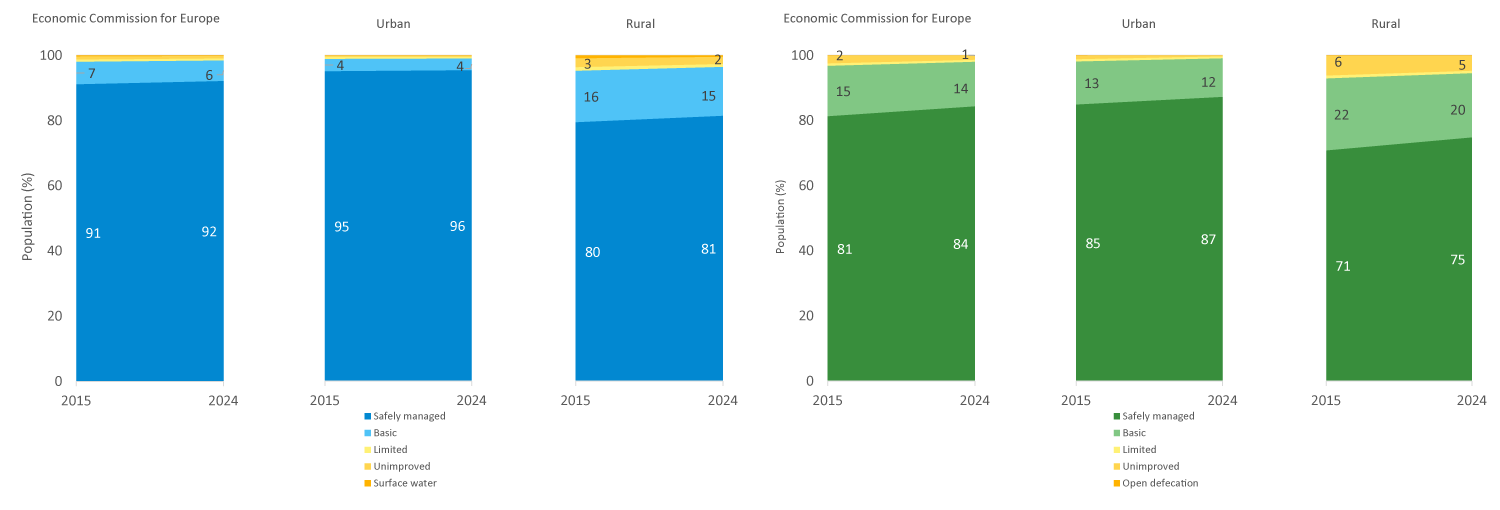
Since 2015, 55 million people have gained access to safely managed drinking water services7. Coverage has increased from 91 to 92 per cent, rising from 80 to 81 per cent in rural areas and from 95 to 96 per cent in urban areas (Figure 5). By 2024, the number of people who still lacked even a basic drinking water service had decreased by 4.4 million and the number of people using surface water for drinking had decreased by 1.5 million.
7 For regional estimates, refer to JMP 2025 WASH in households regional snapshots (<https://washdata.org/how-we-work/country-and-regional-engagement/regional-analysis-2025-household-update>). For figures presented in this regional summary, refer to the JMP 2025 ECE Regional Snapshot. Link: https://washdata.org/files/JMP-2025-RC-ECE-ALL-Economic-Commission-for-Europe.xlsx.
Similarly, 78 million people have gained access to safely managed sanitation services since 2015. Coverage has increased from 81 to 84 per cent, rising from 71 to 75 per cent in rural areas and from 85 to 87 per cent in urban areas (Figure 5). By 2024, the number of people who still lacked even a basic sanitation service had decreased by 6 million.
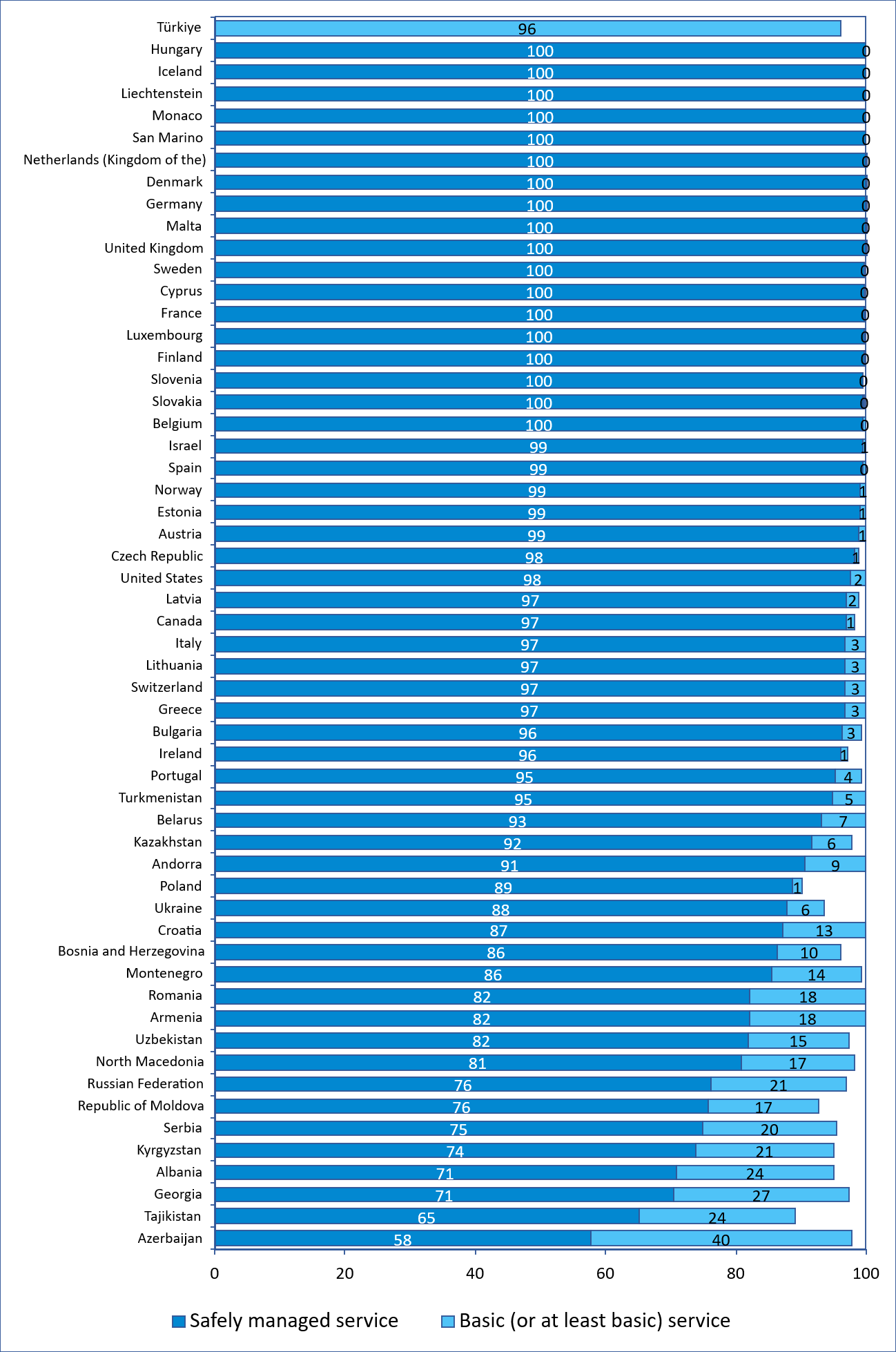
In 2024, among 55 UNECE countries with safely managed drinking water estimates8, 18 had already achieved universal access (>99 per cent) to safely managed drinking water services (Figure 6). There were 5 countries with less than 75 per cent coverage, including one country below 60 per cent.
8
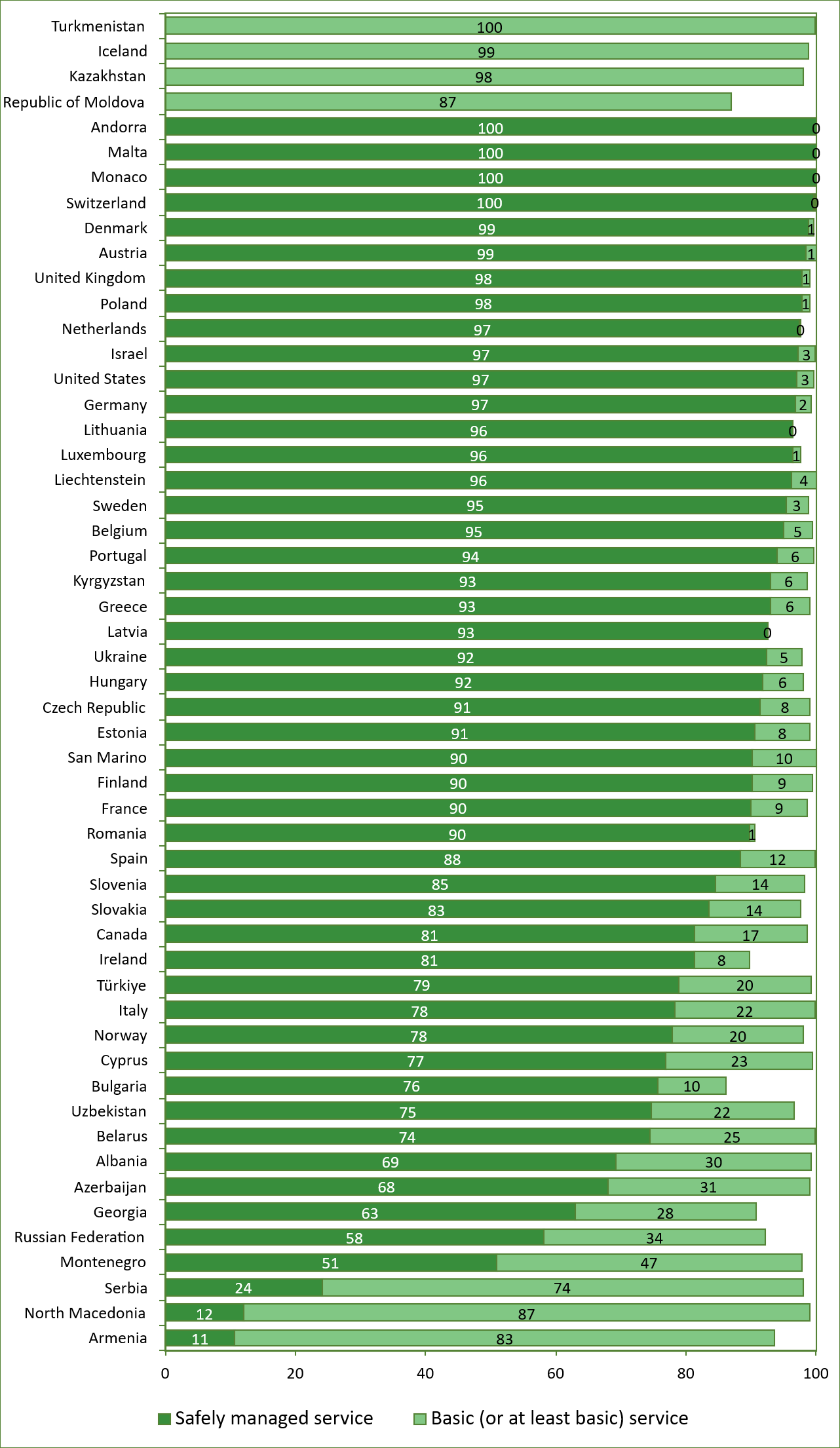
Although overall coverage of WASH services was high in the region, there were disparities especially in safely managed sanitation coverage. In 2024, among 49 UNECE countries with safely managed sanitation estimates9, only 4 had already achieved universal access (>99 per cent) to safely managed sanitation services (Figure 7). There were 11 countries with less than 75 per cent coverage, including five countries below 60 per cent and 3 countries with less than 25 per cent coverage.
9 There are 4 countries with only basic sanitation estimates (meaning the information required to generate the indicator is missing) and 3 countries (Bosnia and Herzegovina, Croatia and Tajikistan) without safely managed or basic sanitation estimates.
Moreover, the disparities within countries are particularly pronounced for certain groups. For example, although the proportion of Roma living in households without tap water inside the dwelling declined in most countries between 2016 and 2021, Roma are still 10 times more likely than the general population to lack tap water in their homes.10
10 WHO and UNICEF, Progress on household drinking water, sanitation and hygiene 2000–2024: special focus on inequalities. Geneva, 2025.
As the UNECE region enters the last five years of the 2030 Agenda, progress on household water and sanitation presents a mixed picture. The region is on track to achieve near-universal coverage of basic drinking water and basic sanitation services, reflecting sustained investments and strong service infrastructure in most countries.
However, this overall success masks significant challenges. Progress in SDG indicators for targets 6.1 and 6.2, is far too slow to achieve universal coverage by 2030. Current rates of progress would need to increase ten-fold for drinking water and seventeen-fold for sanitation. Moreover, large disparities persist between countries and within countries, particularly in safely managed sanitation, where only a small number of countries have reached universal coverage.
Data gaps further constrain effective monitoring and policy action. While drinking water and sanitation data are available for around half of the region’s population, information on hygiene services remains extremely limited, preventing an assessment of progress towards universal access to basic handwashing facilities. Persistent inequalities affecting disadvantaged groups, such as Roma communities, highlight that access to WASH services is not only a technical challenge, but also a question of equity, inclusion and human rights.
Without accelerated action, targeted investments and improved data systems, the region risks falling short of its commitment to ensure safe, equitable and sustainable WASH services for all by 2030.
11 Safely managed is the highest level of service. The lighter colour area shows people who do not have safely managed services.
12 Safely managed is the highest level of service. The lighter colour area shows people who do not have safely managed services.
United Nations Economic Commission for Europe
Palais des Nations, Geneva


