


Empowered cities, equipped with clear mandates, adequate resources and coherent multilevel governance, are uniquely positioned to turn the SDGs into tangible local progress. When local authorities can access reliable data, apply evidence-based planning tools and work in partnership with national governments, civil societies, communities and the private sector, global commitments translate into better neighbourhoods, safer streets, greener public spaces and more inclusive services. Investing in city leadership and capacity is therefore a core pathway to deliver measurable improvements in people’s daily lives—especially for those most at risk of being left behind.
Urban areas are the frontlines of sustainable development. Over half of the world’s population now lives in cities, where challenges such as housing inadequacy, inequality and weak local governance structures threaten to stall progress on the 2030 Agenda. At the same time, urban agrifood systems face increasing pressures, including ensuring food security, nutrition and health for all; enhancing environmental sustainability through waste management and the reduction of food loss and waste (FLW); supporting inclusive economic growth and sustainable livelihoods, reducing gender and socio-economic inequalities, and addressing resource-intensive consumption patterns. These interlinkages demonstrate the relevance of food systems across multiple SDGs.
SDG 11 calls for inclusive, safe, resilient and sustainable cities, while SDG targets 11.3, 11.a and 16.7 emphasize participatory planning, multilevel governance and inclusive decision-making. Yet, many cities lack the institutional capacity, data systems and policy frameworks needed to deliver on these aspirations.
As the permanent co-chair of the Local 2030 coalition, UN-Habitat has supported local and regional governments engage in UN processes, advocacy and capacity building. The Local 2030 Coalition is the UN-system platform to accelerate the SDGs through localization of the 2030 Agenda, enhancing coherence, efficiency and local impact. Guided by the Bilbao Blueprint (a framework that shares tools and practices to help local governments plan and implement sustainable development strategies) and the SDG Localization Marker (a tool to track and align funding with local SDG priorities), the Coalition helps channel resources to the local level and track their impact with greater transparency and accountability.
Recognizing this, UN-Habitat’s corporate approach, SDG Cities, connects global goals with local realities by supporting cities collect and use data, strengthen governance systems and design integrated policy frameworks that foster catalytic investments. Central to this approach are Voluntary Local Reviews (VLRs), processes that help cities assess progress, align local actions with national strategies and ensure coherence with their countries’ Voluntary National Reviews (VNRs). In 2025, FAO has been working closely with UN-Habitat to strengthen the focus on agrifood systems in VLRs, as a key entry point for SDG acceleration at the local level.
When the process began in Poti and Khashuri (Georgia), Trebinje, Kakanj, Bijeljina and Maglaj (Bosnia and Herzegovina), local administrations were confronted with a set of shared obstacles that limited their ability to advance sustainable urban development. Data systems were fragmented, making evidence-based planning and monitoring difficult, while local capacities to translate global frameworks such as the SDGs into practical policy actions remained limited. Misalignments between local and national plans led to inefficiencies and duplication and many cities faced rising socioeconomic inequalities driven by rapid urbanization, housing pressures and environmental stress. In addition, the relevance of agrifood systems at the local level—especially within the context of VLRs—was not yet fully understood or integrated into planning. Opportunities for peer learning and experience sharing across the wider ECE region were also limited, leaving cities without the networks needed to innovate and scale solutions.
UN-Habitat and FAO supported these cities through the SDG Cities approach, providing technical guidance, peer learning and participatory mechanisms to translate the SDGs into actionable local strategies. The process unfolded through several interconnected steps:
1. Capacity-building and technical support: municipal teams and national experts participated in targeted workshops on SDG data, spatial analysis, policy planning, agrifood systems and multilevel governance. Coordination mechamisms ensured alignment with the global SDG Cities Framework. An inter-agency mechanism involving FAO, UN-Habitat and UNDP Georgia supported experience-sharing between Bosnia and Herzegovina and Georgia. Regional exchange was further promoted through a regional technical workshop on VLRs and SDG localization organized by FAO and UN-Habitat.
2. Participatory consultations and co-creation: cities convened multi-stakeholder consultations involving local governments, academia, civil society and youth to define priorities across housing, climate resilience, agrifood systems and local economic development.
3. Data frameworks and policy integration: cities developed localized indicator frameworks aligned with national SDG monitoring systems. To support VLR development and strengthen agrifood systems integration, FAO is developing a regionally tailored list of agrifood systems-related indicators for local use, already piloted in municipalities in Bosnia and Herzegovina and Georgia.
4. VLR development and national alignment: the process produced action-oriented VLRs serving as planning tools rather than reporting exercises. Each VLR informed national SDG processes, strenghthening VLR-VNR linkages and policy coherence.
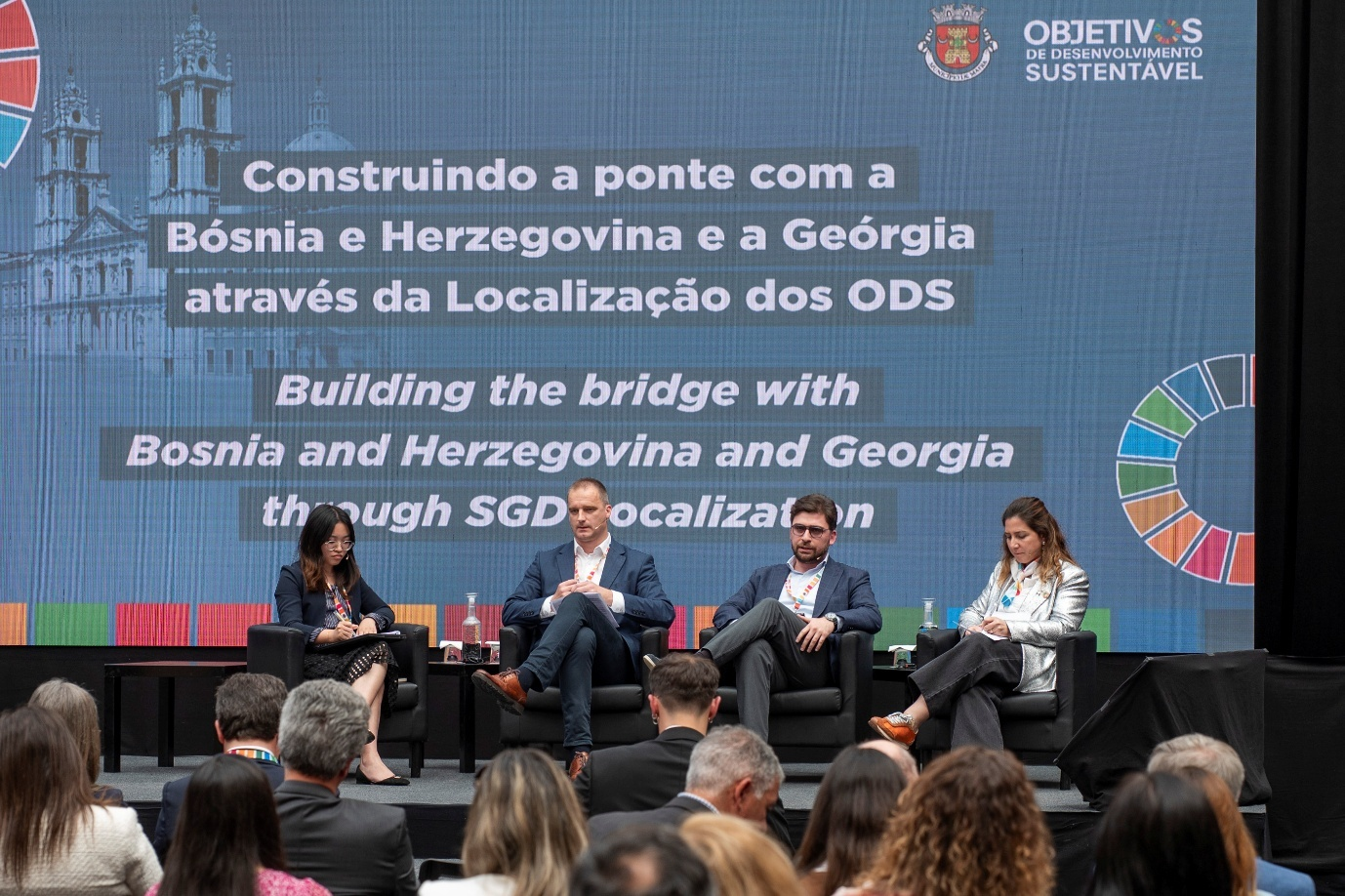
5. Learning and peer exchange: a study tour was organized for municipalities from Bosnia and Herzegovina and Georgia to Mafra, Portugal, focusing on VLR development and agrifood systems-related initiatives, including biodiversity, water reuse and waste management. Participants also engaged in the second SDG Workshop for Lusophone Countries.
The VLR and follow-up processes have generated measurable institutional and policy gains:
Institutionalization: VLRs are now embedded in municipal planning cycles, strenghthening SDG localization.
Data ecosystems: all six cities developed SDG indicator frameworks supporting systematic monitoring and evidence-based decision-making.
Multilevel coordination: collaboration between local governments, ministries and UN agencies improved policy coherence.
Inclusion and participation: civil society, youth and academia contributed directly to VLRs, reinforcing the “leaving no one behind” principle.
Peer learning: cities expanded regional exchange through workshops and study tours.
Agrifood systems integration: VLRs increasingly reflect agrifood systems as a catalytic area for SDG acceleration.
The experience of participating cities demonstrate that SDG localization is a transformative process that strengthens governance, fosters inclusion and builds the foundation for long-term prosperity.
The subsequent JSDF projects in Kyrgyzstan and Serbia, jointly implemented with UNECE, UNDP, Kyrgyzstan, UNICEF Serbia and UNEP illustrate a shift from planning to implementation and translating VLR insights into tangible investments. FAO has reinforced the role of agrifood systems within action-oriented VLRs as a catalyst for systems thinking and SDG acceleration.
By institutionalizing SDG localization and strenghthening multilevel collaboration, these cities are not only reporting on progress but actively shaping pathways toward more sustainable and equitable urban futures.
United Nations Economic Commission for Europe
Palais des Nations, Geneva


