



SDG 17 is the enabling goal of the 2030 Agenda, through which partnerships, financing, technology, capacity and data systems are mobilised to enable progress on all other goals to be planned, measured and corrected in real time. When data are missing, updated irregularly, or not comparable across time and countries, decision-makers are unable to reliably detect early slippage, allocate budgets strategically or demonstrate whether children most at risk are being reached.
This is why the SDG target 17.18 is directly relevant to child outcomes. It calls for a significant increase in the availability of high-quality, timely and reliable data, including appropriate disaggregation within national contexts. However, UNICEF analysis based on its latest assessment of progress against child-related SDG indicators shows serious data gaps. This poses a risk to sustained progress and evidence-informed decision-making.
The assessment is based on the recently developed regional Child-related SDG Progress Dashboard16, which allows policymakers and stakeholders to review progress specifically for 47 child-related indicators (113 series) which are most relevant to the Europe and Central Asia region.
16 https://www.transmonee.org/child-related-sdg-progress-dashboard
The methodology also benefited from the approach used in the recent reports by UNESCAP and UNECE, further adapted to child-related SDG indicators. Additional consultations with UNESCAP were also held to discuss the proposed changes. All computations use the UNDESA Global SDG indicators database and the main unit of analysis is a series. The series codes are used to identify the specific sub-indicator series reported under an SDG indicator.
Country indicators (series) are included in the current progress measurement only when they have at least two data points, namely a baseline value from 2015 to 2019 and a recent value from the last five years, (2020 to 2024). The targets were derived from the global SDG framework. Some of these are absolute values while some relative values. In cases when no global target is indicated, the average of the top 5 performers was used as an aspirational regional benchmark.
Current progress status scores are grouped into seven categories for interpretation: On-Track, Moderate Progress, Marginal Progress, Stagnation and Regression. Two additional categories capture data gaps: Insufficient Data (missing baseline or recent data) and No Data (no data available at all in the SDG database).
The overall picture is mixed. Of the 113 indicator series representing 47 child-related SDG indicators, on average, the region is on track for 26 per cent of indicator series, while 16 per cent show stagnation and regression.

Considerable progress has been made by most of the countries for some indicators, namely on, maternal mortality (Target 3.1), childhood mortality (Target 3.2) and birth and death registration (Target 17.19).
Least progress has been made for indicators concerning anaemia in women 15-49 (Target 2.2), universal health coverage service (Target 3.8), minimum proficiency in reading and mathematics (Target 4.1) and immunization (DTP3 and measles, Target 3.b.1). Either stagnation or regression was seen in most of the countries.
The data gaps (no data available or insufficient data) for trend analysis, particularly affect targets for indicators concerning multidimensional poverty (Target 1.2), government spending (Target 1.a), social transfers (Target 1.3), child wasting (Target 2.2), ambient air pollution (Target 3.9), child development, child labour, physical and/or sexual violence (Target 5.2), child disciplining (Target 16.2).
Across 54 countries, the data availability in the region is 52 per cent when measured by the availability of at least two data points since 2015. If modelled further and estimated data are excluded from the analysis, the data availability declines to 30 per cent.
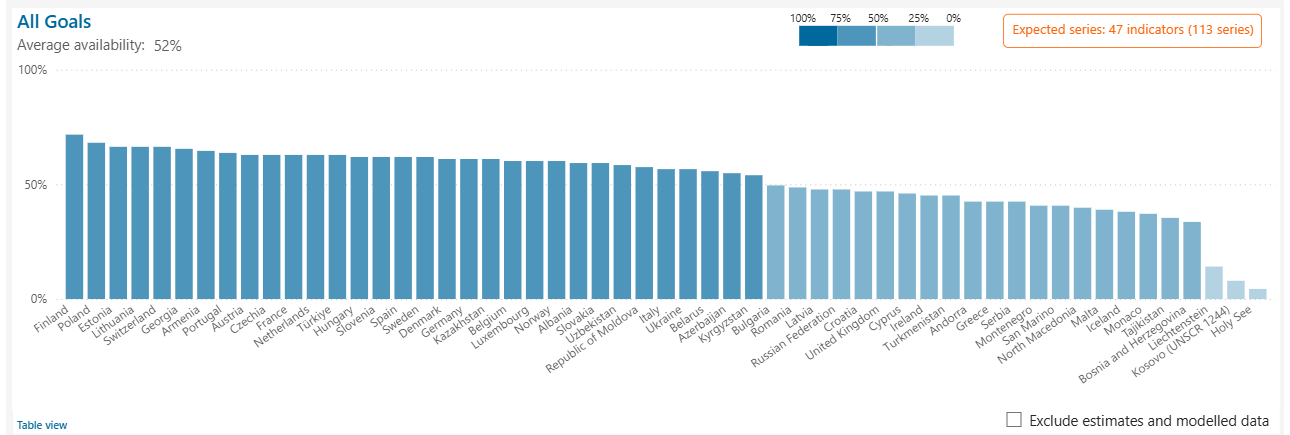
17 https://www.transmonee.org/availability-and-recency-data-child-related-sdg-indicators
These assessments do not consider the availability of disaggregated data and the achievement of SDGs for all groups of children. Such disaggregation requires systematic collection and analysis of data for the furthest behind. UNICEF has been partnering with many governments in the region to collect much-needed data for SDG indicators at disaggregated levels primarily through Multi Indicator Cluster Surveys (MICS).
With less than five years remaining to achieve the 2030 Agenda, the Europe and Central Asia region faces a dual challenge: progress on child-related SDG targets is uneven and data gaps undermine the ability to act. While some indicators show promise—such as reductions in maternal and child mortality—less than a third of all child-related indicator series are on track. Nearly 50 per cent lack sufficient data to even measure progress.
These deficits matter. When governments lack timely, disaggregated and high-quality data, they are unable to identify children who are most left behind, adjust programs or hold themselves accountable. The most vulnerable—children living in poverty, migrants, Roma and children with disabilities—are most likely to be obscured in national averages.
The solution is clear: child-focused data systems must be strengthened without delay. UNICEF’s work with governments across the region through MICS and related partnerships provides a proven model. However, more is needed: data systems must be institutionalized, adequately resourced and integrated into national statistical system to ensure continuity and sustainability. Investing in data is not merely a technical afterthought. It is a political decision to prioritize children. With it, governments can deliver results more efficiently, equitably and at the pace required.
United Nations Economic Commission for Europe
Palais des Nations, Geneva


