



Bridging the global infrastructure financing gap is no longer an option — it is imperative. Sustainable transportation, resilient energy systems and digital networks form the backbone of inclusive growth and climate action and are essential for improving connectivity across regions and communities. Enhanced connectivity not only drives economic integration but also supports aging societies by enabling access to healthcare, social services and digital solutions that reduce isolation and improve quality of life.
Yet trillions of dollars remain missing from the equation. Public budgets alone cannot meet this demand and private financiers often remain cautious without clear frameworks for risk and impact. Public-Private Partnerships (PPPs), despite their mixed track record, offer a pathway forward when designed with transparency, sustainability and resilience at their core.
To achieve the SDGs, PPPs must be reimagined and made fit-for-purpose, delivering not just infrastructure but inclusive, sustainable impact.
Traditional PPPs, with their narrow focus on “value for money,” often failed to deliver the transformative impact needed to achieve the SDGs. By prioritizing short-term cost efficiency, many projects overlooked critical targets such as SDG 6.1 (universal access to safe and affordable drinking water), SDG 7.2 (renewable energy expansion) and SDG 9.1 (developing quality, reliable, sustainable infrastructure). This gap underscored the need for a new PPP model — one that places sustainability and people at its core and supports SDG 17.17, which calls for effective partnerships to mobilize and share knowledge, technology and financial resources.
In 2015, the baseline was clear: very few PPPs embedded sustainability principles and even fewer PPP concessionaires went beyond contractual obligations to consider community well-being and long-term impact.
For the past decade, UNECE has led the shift through its normative PPP tools, culminating in the launch of the PIERS evaluation methodology in 2022 — a true game changer. PIERS translates policy into action by providing governments and stakeholders with a practical, evidence-based tool to measure project impact against SDG objectives. Its five dimensions — access and equity, economic effectiveness and fiscal sustainability, environmental sustainability and resilience, replicability and stakeholder engagement — ensure that PPPs deliver tangible benefits for communities and future generations.
The impact is real: PIERS has assessed projects across multiple countries, transforming well-executed PPPs into drivers of sustainable development. PIERS has helped users move beyond compliance toward proactive community and environmental engagement.
Empirical evidence from two landmark projects in Türkiye – the 1915 Çanakkale Bridge and the Eurasia Tunnel — demonstrates this transformation. Initially designed to deliver connectivity and economic growth, these projects evolved into holistic sustainability platforms through PIERS-driven evaluation and action, combined with the concessionaires’ commitment to being good neighbours to their communities.
The PIERS application demonstrated that transport infrastructure projects, by fostering connectivity, also deliver broader sustainability gains across a wide range of SDGs, underscoring their value beyond transport alone.
PIERS was instrumental in:
Mapping activities against SDG targets to clarify impact
Identifying gaps, such as the absence of community disaster-preparedness plans
Triggering new actions to strengthen resilience and stakeholder engagement
Helping to articulate a coherent, evidence-based SDG narrative
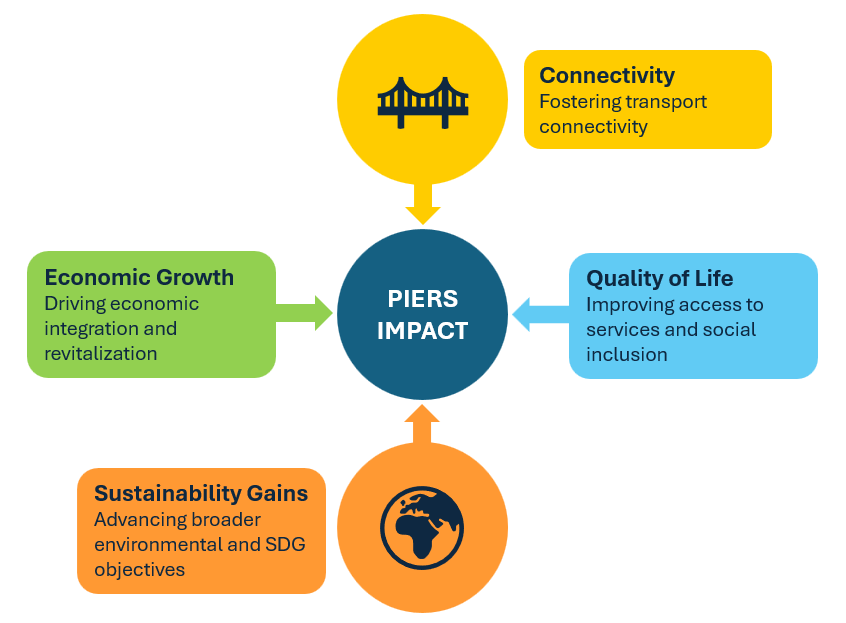
To date, the PIERS-enhanced transformation is complete, as evidenced by the projects’ economic, social and community impact, environmental stewardship, safety and resilience.
The outcomes of these two projects tell a compelling story of transformation:
Over 20 billion USD in lifetime economic value
More than 80,000 jobs created
Revitalized industrial zones, attracting investment and integrating local suppliers into value chains
Transformative mobility gains, with travel times slashed dramatically
Social initiatives empowered women’s cooperatives, strengthened rural livelihoods and expanded community and educational programmes
Environmental initiatives — from large-scale reforestation to biodiversity conservation and carbon-neutral operations — have delivered measurable benefits for both people and nature
Road safety outcomes have improved significantly, supported by advanced emergency-response systems and resilient infrastructure engineered to withstand extreme events
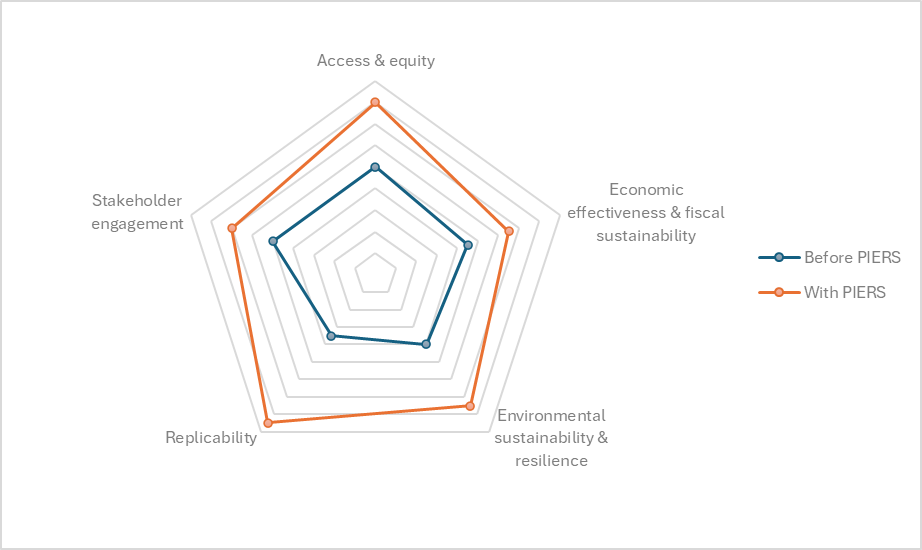
By enabling users to identify, improve and report these indicators with robust data, PIERS has turned infrastructure projects into true SDG accelerators — delivering value for people, planet and prosperity. What began as a tool for self-evaluation has become a catalyst for transformation, proving that when PPPs are designed with sustainability and inclusiveness at their core, they can bridge the infrastructure gap and drive progress toward the 2030 Agenda.
United Nations Economic Commission for Europe
Palais des Nations, Geneva


