


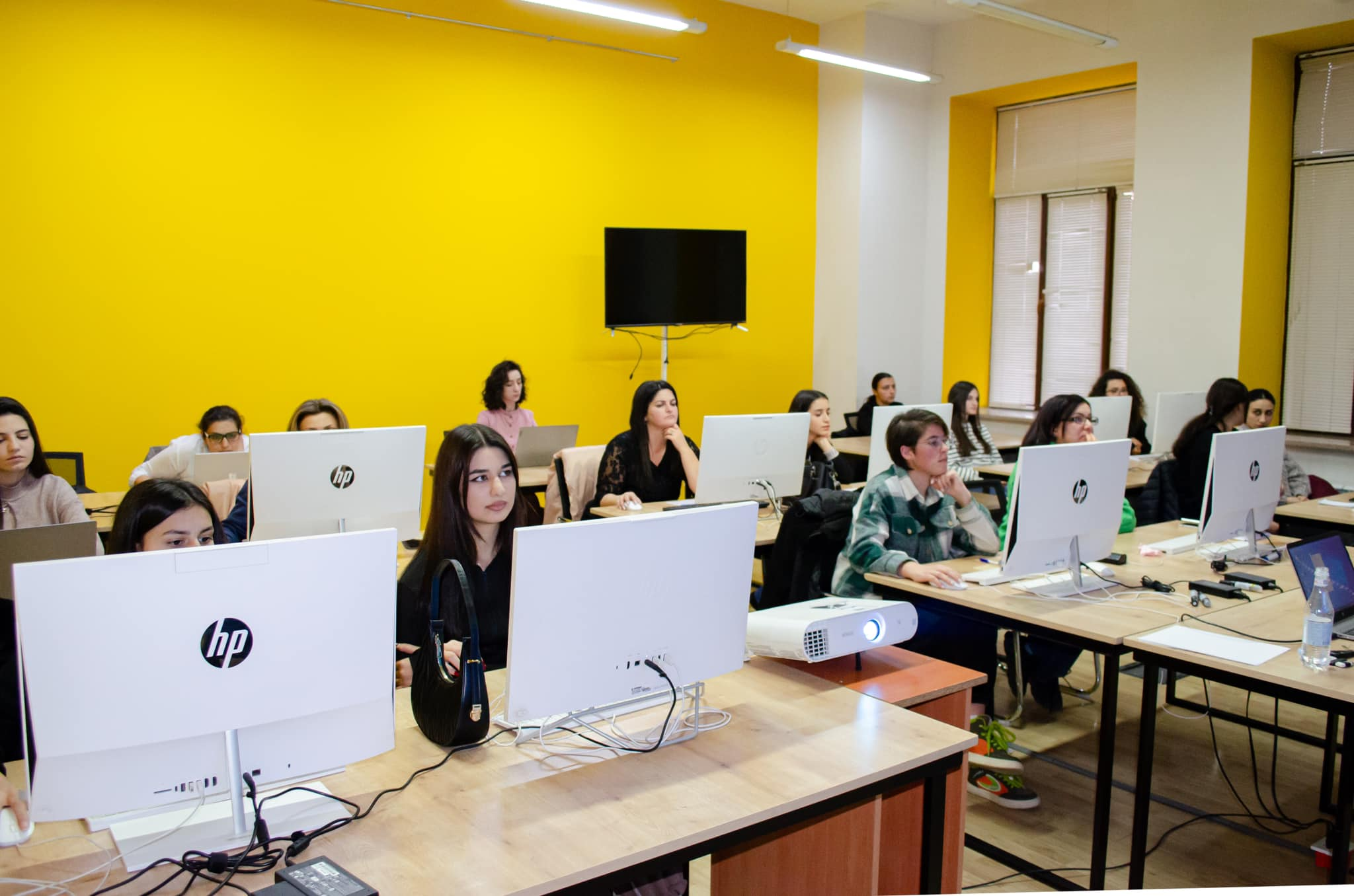
In 2023, UNDP Armenia began cooperating with the Ministry of Labor and Social Affairs (MLSA) to develop Armenia’s new employment strategy to address persistent mismatch between labor supply and demand, labor underutilization (approximately 15 per cent of the labor force in 2022) and low labor competitiveness, particularly in regional towns. As a result, the new Employment Strategy 2025-2031 entered into force, setting an ambitious vision to build a competitive workforce and to expand highly-productive, non-agricultural jobs to reduce regional13 unemployment by 2031.
13 Regions refer to the marzes, the country’s 10 administrative provinces (excluding Yerevan)

To support the Employment Strategy, the Innovation and SDG Finance Portfolio of UNDP Armenia, in cooperation with the MLSA and with funding from the Austrian Development Agency and the European Union, designed and piloted the “Result-Based Financed Active Labor Market Policy” (RBF ALMP) project in 2024. The project is a comprehensive initiative that leverages public–private partnerships to deliver end-to-end training-to-employment solutions. It targets groups facing high unemployment, including NEET youth, women aged 30–40, recipients of social and family benefits and displaced individuals from Nagorno-Karabakh. “We need consistent, targeted and long-term efforts to implement the strategic objectives set in the employment sector. And in this context, continued constructive and coordinated cooperation with partner organizations is of particular importance” – said the Minister of Labor and Social Affairs Arsen Torosyan.
To incentivize market-tailored and demand-driven solutions, RBF ALMP introduced a result-based financing mechanism grounded in the pay-for-success principle. The new result-based financing mechanism shifted funding from inputs to outcomes, providing phased funding based on employment results.
Ten competitively selected private companies, educational centers and CSOs designed and operationalized innovative employment-integration models encompassing participant identification, orientation, skills training, direct job placement and job security (four months and longer on the job). Around 600 participants from target groups were identified and enrolled in the program. Strong participation was recorded in the regions of Armenia, accounting for over 82 per cent of total enrollment – advancing the “leaving no one behind” commitment of the initiative.
The partners adopted agile, context-specific approaches to analyze local labor markets, assess demand, conduct outreach and select participants. Individual yet holistic approaches were applied for identifying career interests and existing skillsets and to deliever tailored orientation, reskilling and upskilling, as well as psychosocial support. Finally, job-liaison services were provided to support job placement and security.
These approaches aimed not only to build technical competencies but also transversal skills and strengthening foundations for sustainable job integration. Ten high-demand occupational areas were identified—including ICT, sales and communications, and catering. Zhaneta Ayvazyan, a displaced woman settled in a rural area shared, “The program was not just about technical skills, it transformed my mindset, I understood that career can be built even in the most difficult life situations․ This opportunity restored my confidence and brought stability to my family—they see that I move forward and that gives them strength.”
To support the continuous improvement and sustainability, a robust monitoring, evaluation and learning (MEL) framework was established to facilitate data-driven decision-making, scaling-up of RBF ALMP models and foster continuous policy enhancement. Moreover, a set of evaluation instruments have been developed to support process optimization, including a complex formula to assess ALMP partner proposals and financing distribution.
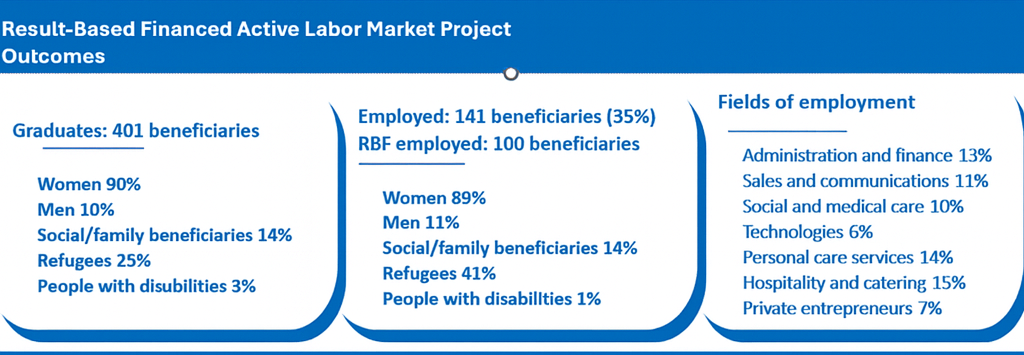
By November 2025, 401 participants had successfully completed reskilling and upskilling programes, with many also receiving individualized and needs-tailored psychosocial assistance, auxiliary skills training, and career counseling. Within one to five months, 141 long-term unemployed graduates (35 per cent of total graduates) secured registered employment, with nearly 10 per cent establishing their own microenterprises. Among the employed, there was an outstanding representation of women (89 per cent) and displaced individuals from Nagorno-Karabakh (41 per cent). Moreover, verified monthly salaries of beneficiaries in rural areas, were more than twice the minimum wage, indicating that achieving competitive earnings across different geographies is feasible with holistic market-tailored models. Manya Shermazanyan, a mother of a child with special needs shared, “I rediscovered myself, built a new profession and now have a growing business that helps me support my child. This program didn’t just change my life—it gave it back to me. My wonderful daughter says that when she grows up, she wants to be like me — and that is the greatest success for me”

Importantly, MEL analysis generated insights to further refine the models. For example, on-the-job training delivered immediate employment outcomes for over 71 per cent of participants, compared with approximately 2.9 per cent for classroom-only training, confirming the effectiveness of employer-linked models. Flexible hybrid training formats expanded access for rural women and caregivers as well as strengthened motivation, group dynamics and the overall engagement. As Sirun Melkumyan—a displaced beneficiary—explained, “This program opened doors to a new environment, helped me overcome displacement-related trauma and allowed me to support others in need.”
Building on these and other findings, UNDP Armenia and MLSA are working to adjust and optimize the models through targeted policy and operational improvements. This joint effort is laying the groundwork for embedding these approaches in the Employment Strategy action plan and the national MEL system, enabling national scalability. “The RBF ALMP has demonstrated an exceptional promise,” said Ruben Sargsyan, Deputy Minister of Labor and Social Affairs,“ not only in the innovation of models but in the lessons, we are already gathering data on how to make employment interventions more efficient and policies more effective. This is a unique initiative that brings together UNDP and the Government around a shared mission: improving Armenia’s labor market through evidence-driven, scalable solutions”.
To further strengthen digital readiness and employability, UNDP has developed Digital Upskilling (DU) 1.0 and 2.0 training courses grounded in European Commission’s DigComp 2.2 framework, which offer foundational and intermediate-level digital skills. Since 2023, more than 1,800 women, predominantly from the regions of Armenia, have completed the digital literacy courses and received certifications. Collectively, these initiatives have helped beneficiaries acquire the competencies needed to participate in today’s digital economy. A displaced woman, Arpine, shared, “The program helped me restore my ability to learn, improved my memory and confidence and gave me the skills to use digital tools without fear.”
The strong demand for and success of DU 1.0 and 2.0 led to a more ambitious plan—creating a nationwide ecosystem of digital and AI literacy to support workforce transformation, enhance competitiveness and enable all citizens to contribute to Armenia’s digital future. Building on the momentum, UNDP Armenia is now developing an operational AI course to be integrated into a nationwide learning platform and plans to further expand it with AI literacy for entrepreneurs and SMEs. As Ruben Sargsyan, Deputy Minister of Labor and Social Affairs mentioned, “UNDP is unparalleled in its ability to design and operationalize complex pilot initiatives—from RBF ALMP to Digital Upskilling—starting from zero. We highly value that the Digital Upskilling initiative is now expanding into AI literacy, equipping unemployed individuals with the skills needed for an increasingly digital labor market.”
United Nations Economic Commission for Europe
Palais des Nations, Geneva


