

The arrival of more than 100,000 refugees from Nagorno-Karabakh in 2023 placed immense pressure on Armenian host communities. With limited budgets and aging infrastructure, communities had to rapidly adjust to serve significantly increased populations. Many lacked even the most basic shared spaces where people could gather, interact and reconnect with community life. Without such environments, dialogue between host residents and refugees remained limited, making integration challenging and weakening social cohesion.
To respond to these needs, UNDP Armenia launched a “Resilience from the Start” project, implemented by the Gender Equality Portfolio, with a focus on co-design of gender-sensitive and inclusive multifunctional public spaces in partnership with communities. Masis, Khoy, Pambak, Ijevan and Areni communities were selected based on high refugee presence, gaps in public infrastructure and strong municipal readiness to co-design, co-finance and sustain new services. Across consultations, residents repeatedly voiced the same concern: integration is nearly impossible when there is no place to meet. Refugees felt disconnected; long-time residents struggled to adapt to rapid demographic change.
To bridge these divides, the project introduced a participatory service development and a delivery model grounded in co-design with service recipients and service providers, community validation and user-centered planning. Instead of designing for communities, UNDP and communities co-designed with them. This ensured that every space reflects real needs, strengthens trust and cultivates a shared vision of inclusive resilience.
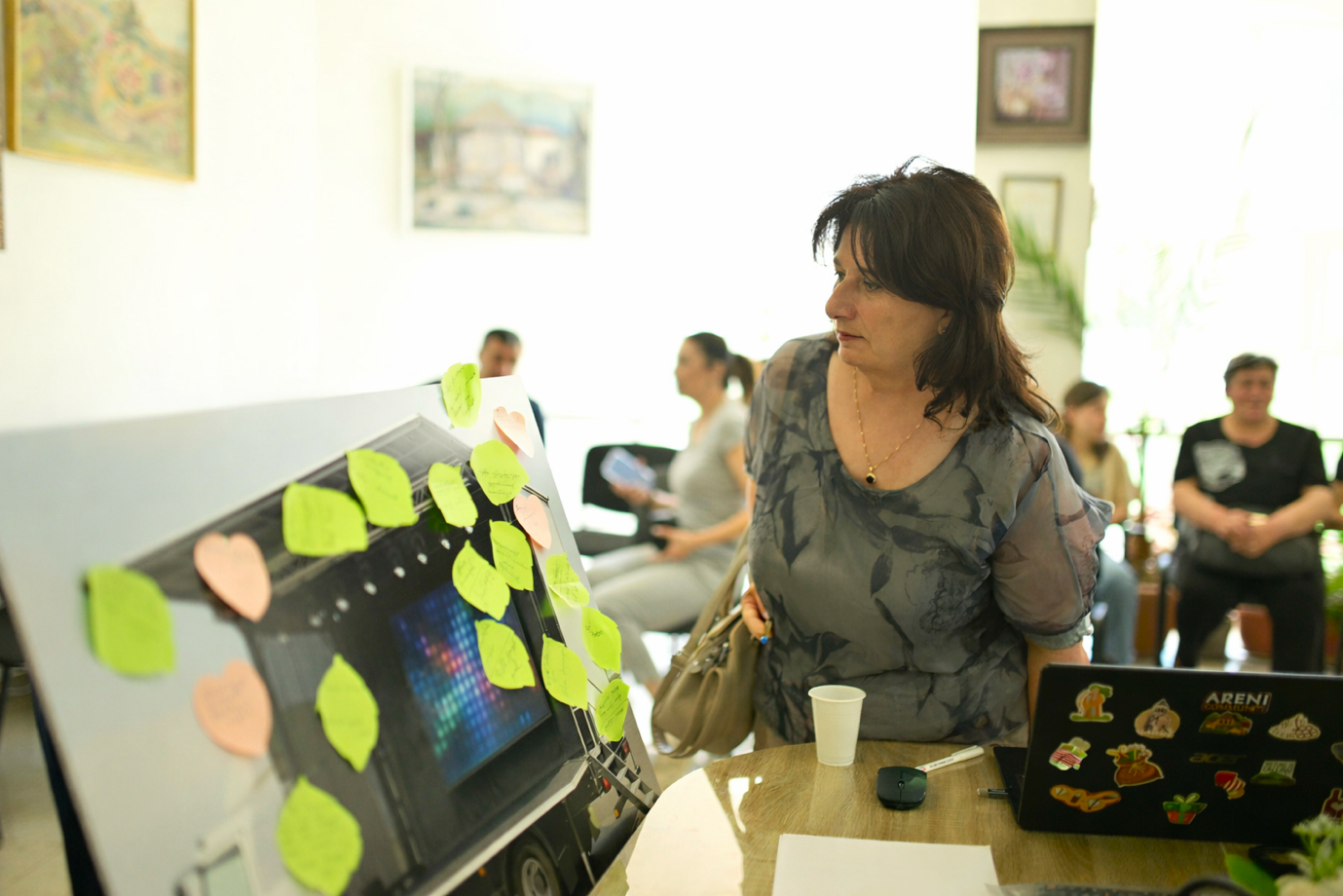
This shift-from top-down planning to genuine co-creation became one of the initiative’s most transformative dimensions. Residents who had rarely been involved in municipal decision-making suddenly found themselves shaping the spaces that would define their daily lives. Refugees, women and youth contributed insights that influenced everything from accessibility features to cultural programming. Communities engaged, adapted and co-created solutions, transforming public space design into a platform for rebuilding trust and fostering meaningful social connection.
More than 500 residents – predominantly women, youth and refugees – participated in needs assessments, brainstorming sessions, co-design workshops and validation meetings. These were not symbolic exercises; ideas were debated, prioritized and translated directly into architectural plans. As one resident shared: “For the first time, our ideas are shaping something real in the community.” The process reshaped relationships between communities and Local Self-Governance and laid the foundation for long-term collaboration.
All public spaces were designed according to UNDP’s global gender equality and social inclusion standards. They include safe and well-lit environments, accessible and barrier-free pathways, zones tailored for girls, boys and youth, flexible cultural and educational areas and environmentally sustainable features. These elements ensure that public spaces are welcoming for those traditionally excluded, especially women, girls and persons with disabilities.
All five communities committed to long-term operation and maintenance and contributed 50 and 140 per cent co-financing, mobilizing over 260,000 USD in local resources. In the context of limited municipal budgets, this level of investment reflects exceptional ownership and a shared commitment to sustaining inclusive community services.

The project was implemented in close collaboration with the Republic of Armenia Ministry of Territorial Administration and Infrastructure, ensuring alignment between national reforms and financial support of the Government of Serbia.
Three outdoor and one indoor space—totaling approximately 3,250 m²—have been transformed into vibrant gathering areas for sports, educational, cultural and leisure activities. In Areni, where community spaces are scarce, a mobile stage truck will bring cultural and educational programming to remote settlements, extending access beyond physical square meters. Together, these interventions create inclusive environments where women, youth, persons with disabilities, refugees and host community residents can interact and participate on equal terms.
These spaces enable municipalities to deliver sports, cultural and educational services through multifunctional public spaces, creating opportunities to introduce new services. In addition, the project introduced a digital subsystem for assessing municipal sectoral services in five target communities, enabling residents to ‘close the loop’ by participating first as co-designers and later as evaluators, ensuring continuous improvement in service delivery.
For the first time, municipalities stepped forward, not only as beneficiaries of external support but as co-financiers of community infrastructure. This shift marked a significant departure from traditional practice and created a powerful sense of ownership at the local level.
For many residents, it was the first time their ideas influenced public decisions. Refugees, initially hesitant, gradually became confident contributors. Communities shifted from being passive beneficiaries to co-authors of change, strengthening trust with Local Self-Governance and cultivating shared responsibility.
|
SDG Indicator
|
Evidence from the Project
|
How the Project Contributes
|
|---|---|---|
|
9.1.1
|
~180,000 indirect and 28,500 direct beneficiaries, incl. ~3,500 refugees
|
Expands access to essential community infrastructure and promoting sustainable and inclusive local infrastructure
|
|
11.3.2
|
500+ residents engaged in co-design; majority women, youth, refugees
|
The project contributed to the participatory, accessible urban development
|
|
11.7.1
|
~3,250 m² spaces transformed; mobile stage truck for outreach
|
~3,250 m² spaces transformed; the mobile stage truck will create a public space by reaching all settlements of the community
|
|
17.17.1
|
Municipal co-financing 50–140 per cent; 260,682 USD mobilized
|
Municipal co-financing 50–140 per cent; 260,682 USD mobilized, fostering effective collaboration among local authorities and development partners
|
Armenia’s experience shows that public spaces become powerful engines of social cohesion when they are co-designed with people who will use them. The inclusive process of sitting together, sharing ideas, negotiating priorities has been just as transformative as the spaces themselves. Transformed areas are not only gender-sensitive and inclusive; they are clear manifestations of trust, shared ownership and community resilience. They are places where refugees meet neighbors, where youth feel seen, where women shape decisions and where communities and local governments build a new, more collaborative model of partnership.
United Nations Economic Commission for Europe
Palais des Nations, Geneva


