





Chapter 11 Challenges, successes and lessons learned

Detailed information on challenges, successes and lessons learned in the UNECE survey is available in the Challenges, successes and lessons learned section of the UNECE 2020 Census Round dashboard
 11.1 Introduction
251.
251. In the last census round – as in previous censuses – many changes were introduced to reflect the need to reduce costs and improve efficiency and quality, to take advantage of developing technologies and methodologies, or to respond to emergencies such as the Covid-19 pandemic. Such changes may, or may not, bring success but they all present challenges. This chapter notes some of the key challenges faced by countries in the 2020 round as reported in the UNECE survey, but also shows the other side of the coin by commenting on some of the successes.
11.2 Challenges
252.
252. The survey asked countries to assess and rank some 27 different challenges or obstacles in conducting their 2010 census. For each challenge, respondents were asked to indicate one of four levels of difficulty from ”significant challenge” to ”not a challenge”, or to indicate if a challenge was not applicable for whatever reason (for example, where a particular activity or process was not relevant to the census methodology adopted by the country – such as improving/maintaining participation rates or response rates in the case of a wholly register-based census). No criteria were provided to define the scale, so responses were, to some extent, subjective. Responses were submitted by 39 countries, but some countries did not respond to particular individual challenges. Table 44 shows the results.
253.
253. Quality-related issues were the ones that seem to have presented the most widespread difficulties across the region. Some 36 countries (all but 3) reported at least some level of difficulty in improving or maintaining data quality. Other challenges reported by almost all countries include improving/maintaining participation and response rates (not a challenge for only 3 countries); managing public perception (not a challenge for 4 countries); and improving/maintaining coverage rates (not a challenge for 5 countries). Some of these challenges, however, were ranked as the most significant by a limited number of countries, with the majority of countries rating them only as “medium” or “smaller” challenge.
254.
254. The challenges reported as significant by most countries are: keeping to planned timetable and recruitment (each reported by 16 countries), and complying with health protocols due to the covid pandemic or other health crises (14 countries).
255.
255. It could be expected to see financial resources and keeping to budget as the most frequently reported challenges. Indeed, financial resources were reported overall by 21 countries, and by 5 of them as a significant challenge. Similarly, keeping to budget was reported overall by 25 countries, by 5 of them as a significant challenge.
Table 44
Challenges faced in the 2020 round of censuses (number of countries)
Challenges faced in the 2020 round of censuses (number of countries)
|
Challenges
|
Countries reporting as challenge
|
Significant |
Of which: Medium
|
Smaller |
Not a challenge
|
Not applicable
|
|
Improving/maintaining data quality
|
36
|
6
|
19
|
11
|
3
|
0
|
|
Keeping to planned timetable
|
33
|
16
|
9
|
8
|
6
|
0
|
|
Improving/maintaining coverage rates
|
30
|
10
|
10
|
10
|
5
|
4
|
|
Managing public perception
|
30
|
4
|
16
|
10
|
4
|
5
|
|
Improving data processing/tabulation
|
30
|
4
|
9
|
17
|
8
|
1
|
|
Managing public concerns around privacy and data confidentiality
|
29
|
1
|
13
|
15
|
6
|
4
|
|
Project management
|
29
|
4
|
14
|
11
|
9
|
1
|
|
Implementing quality control/assurance checks
|
28
|
5
|
8
|
15
|
9
|
2
|
|
Data dissemination
|
28
|
5
|
8
|
15
|
9
|
2
|
|
Staff skills and capacities
|
27
|
9
|
9
|
9
|
11
|
1
|
|
Improving/maintaining participation and response rates
|
26
|
10
|
11
|
5
|
3
|
10
|
|
Balancing user needs against respondent burden
|
26
|
2
|
8
|
16
|
6
|
7
|
|
Identifying residential addresses
|
25
|
3
|
7
|
15
|
10
|
4
|
|
Keeping to budget
|
24
|
5
|
6
|
13
|
14
|
1
|
|
Recruitment
|
24
|
16
|
4
|
4
|
7
|
7
|
|
Mapping
|
24
|
2
|
8
|
14
|
9
|
6
|
|
Tackling disinformation/misinformation
|
24
|
4
|
6
|
14
|
8
|
7
|
|
Contract management
|
23
|
3
|
12
|
8
|
9
|
7
|
|
Complying with health protocols due to the covid pandemic or other health crises
|
23
|
14
|
6
|
3
|
11
|
5
|
|
Managing regional and local infrastructures
|
22
|
2
|
9
|
11
|
9
|
8
|
|
Securing necessary financial resources
|
21
|
5
|
8
|
8
|
16
|
2
|
|
Geography (terrain)
|
17
|
1
|
4
|
12
|
14
|
7
|
|
Obtaining legislative or government support
|
16
|
3
|
3
|
10
|
20
|
3
|
|
Overcoming cultural barriers
|
14
|
2
|
3
|
9
|
14
|
10
|
|
Civil unrest, political upheaval
|
12
|
3
|
5
|
4
|
15
|
12
|
|
Disasters caused by natural events (storms, earthquakes, etc.)
|
9
|
1
|
5
|
3
|
14
|
16
|
11.3 Successes
256.
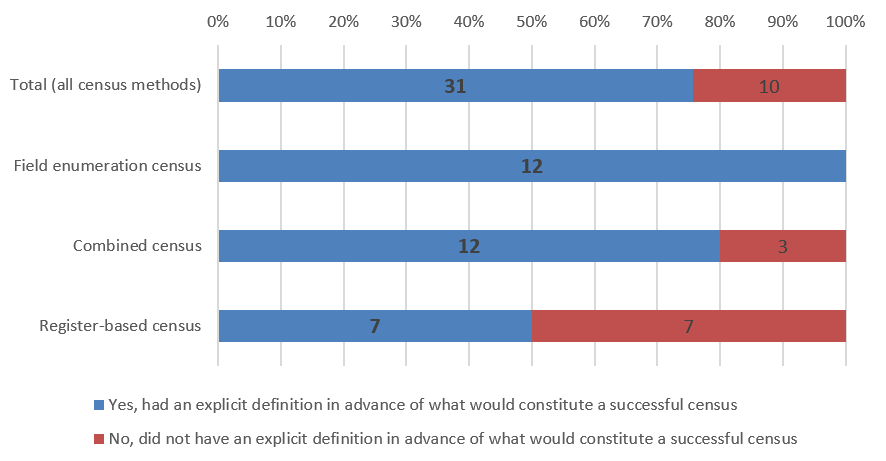
256. It is possible to define a successful census as being one that meets an explicit definition of what would constitute a successful census, or a certain number of pre-defined success criteria. The survey enquired into whether or not countries had an explicit definition in advance of what would constitute a successful census (e.g. a census mission statement and/or key performance indicators). The results are shown in Figure 6.
257.
257. Of all 41 responding countries, three quarters had an explicit definition of what would constitute a successful census, including all countries with a field enumeration census, three quarters of those with a combined census and only half of those with a register-based census. The specific success criteria or key performance indicators identified by the countries are available in the challenges, successes and lessons learned section of the UNECE 2020 Census Round dashboard.
Figure 6
Countries having an explicit definition in advance of what would constitute a successful census
Countries having an explicit definition in advance of what would constitute a successful census
258.
258. Countries were also requested to indicate the areas in which their census was particularly successful. This time 42 countries responded. The results are shown in Table 45.
259.
259. The area reported by most countries (28) is keeping to budget, reported by two thirds of the countries, more often for field enumeration censuses (83%) than for register-based censuses (54%). This could mean that keeping to budget is more often a challenge (to be considered a success if the objective is met) for field enumeration censuses than for register-based censuses. Almost as many countries (27) reported that improving IT and census methodology was a success, again more often for field enumeration censuses than for register-based censuses. or maintaining data quality was regarded as successful. Meeting deadlines was reported as a success by 26 countries, with similar percentages for the three census methods.
Table 45 Areas in which the census was particularly successful (number of countries)
|
Census areas
|
Total
(42 countries) |
Type of census
|
|||
|
Field enumeration (14 countries)
|
Combined
(15 countries) |
Register-based
(13 countries) |
|||
|
Keeping to budget
|
28
|
12
|
9
|
7
|
|
|
Improved information technologies
|
27
|
13
|
10
|
4
|
|
|
Improved census methodologies
|
27
|
10
|
10
|
7
|
|
|
Meeting deadlines
|
26
|
8
|
10
|
8
|
|
|
Improved/maintained data quality
|
23
|
7
|
9
|
7
|
|
|
Improved/maintained response/participation rates
|
21
|
10
|
10
|
1
|
|
|
Improved data dissemination
|
21
|
8
|
8
|
5
|
|
|
Securing necessary financial resources
|
20
|
7
|
9
|
4
|
|
|
Improved logistics and coordination
|
17
|
8
|
6
|
3
|
|
|
Overcoming public resistance
|
16
|
5
|
7
|
4
|
|
|
Implementation of project management methods/tools
|
16
|
6
|
6
|
4
|
|
|
Other
|
10
|
4
|
3
|
3
|
|
11.4 Lessons learned
260.
260. Countries were asked in the survey to indicate the main lessons learned from the census. A short version of some of the replies received is available in Table 46 below. The full replies are available in the challenges, successes and lessons learned section of the UNECE 2020 Census Round dashboard.
Table 46
Main lessons learned in the census
Main lessons learned in the census
|
Country
|
Main lessons learned
|
|
Armenia
|
To have a specific algorithm for selection and training of temporary personnel. Include more registers have fully register based census for next round. Cooperation with administrative sources to improve data quality. The need for the improvement of data quality tools. Development of GIS technologies for census purposes
|
|
Austria
|
Ensuring and maintaining the quality of administrative data remains a challenge – this involves maintaining awareness among the data holders for quality issues
|
|
Bulgaria
|
Conducting a traditional census is a very complex, resource-intensive and expensive task. Recruiting enumerators was a big challenge, particularly in large cities. The general public is becoming more sensitive about sharing personal information and is increasingly hesitant to participate in surveys, especially when it comes to the census.
|
|
Canada
|
Take better advantage of technologies available before/during/after collection: use the Cloud, increase online response target, facilitate access to online questionnaire for all Canadians, use a chatbot and live chat to support respondents, upgrade pay system, increase use of electronic questionnaire validation tools to eliminate Field Edit Follow-Up.
|
|
Croatia
|
Due to the of human resources, the population register should be rapidly established in order to successfully conduct the next population census.
|
|
Czechia
|
Rising non-response. Rising discrepancies between usual and registered place of residence. No more paper forms.
|
|
France
|
It was not so complicated to deal with covid crisis because all the teams are very professional and know well their process and because data dissemination rely on several census surveys and on administrative data sources. The impact on data dissemination was quite small at the end even so we had to cancel one annual census survey.
|
|
Hungary
|
Keep track of the planned timetable is a key factor of the success of any census.
|
|
Iceland
|
Register based census works very well for us, saves time and money
|
|
Ireland
|
A traditional hand delivery/ hand collection Paper Census is not possible at scale, need to move to a multi-mode Census with an online option. Recruitment of field staff is a significant challenge.
|
|
Italy
|
The burden on respondents and on municipalities has to be further reduced. The new methodology puts significant challenges concerning data dissemination. The use of signs of life for the population count has underlined significant groups of hard-to-reach populations, that have to be better dealt with in field enumeration.
|
|
Latvia
|
Moving to the Register based Census helps to decrease cost, to lower staff needed, to improve timeliness of data release. It gives a possibility to collect annual data and store annual data in accumulating data bases. Good cooperation with administrative data owners and keepers on base of bilateral agreements essential for Register based census.
|
|
Netherlands (Kingdom of the)
|
Starting on time and support of the top management are key aspects. Other relevant aspects are combining experienced people and young people bringing new qualifications to the team.
|
|
Poland
|
An important aspect is the large proportion of people enumerated through online self-enumeration (CAWI) – around 60% of all enumerated people. This method is gaining trust among respondents as it is safe and convenient. Thanks to the development of ICTs, future censuses have good prospects, organization can be improved, costs reduced, reduced need for enumerators.
|
|
Portugal
|
Cooperative work at all levels, internal and external to the organization. In the context of the COVID-19 pandemic all the barriers were overcome and it was possible to learn that the partnerships’ approach that we were already implementing, was the right path to establish a more efficient and trustworthy organization.
|
|
Russian Federation
|
The need to create flexible and customisable systems for all stages of preparing, conducting and summarising the census. A realistic assessment by all participants in the process of the capabilities and limitations of the digital census.
|
|
Serbia
|
Implementation of new technologies has significantly improved the census operation, however, taking into account examples of good international practice, it is necessary to increase usage of administrative data and to make conditions for implementing fully register-based census.
|
|
Spain
|
The availability of administrative records generally provides a jump qualitative in the quality of the information with respect to the collection through questionnaires.
|
|
Switzerland
|
It is worthwhile to have an annual census, based on register data and sample surveys. This necessitates a stable system, a stable organization and constitutes a very sustainable solution.
|
|
United Kingdom
|
ONS: Having a good statistical design for the census and a strong, flexible operation design to deliver it. Online response was higher than anticipated and support available allowed a higher digital completion with aided support. Response Chasing Algorithm enabled targeted field response. Comms approach helped ensure minimal barriers to reaching hard to count groups.
|
|
United States of America
|
Flexibility in operational design was key to success during COVID-19 pandemic; rigorous risk management and crisis management processes and tabletop exercises were critical to success when the pandemic hit
|