





Chapter 5 Communication and publicity

Detailed information on communication and publicity collected in the UNECE survey is available in the Communication, outreach and publicity section of the UNECE 2020 Census Round dashboard.
 5.1 Introduction
112.
112. An effective communication strategy together with far reaching publicity and information campaigns play an essential role in ensuring the success of the census. This is especially so for those countries adopting a field enumeration methodology, either wholly or in part, where the general public is expected to actively participate in the census activities as respondents and, possibly, as temporary employees as part of either the field staff or the data processing operation. Even among countries adopting an entirely register-based approach where direct contact with the public may be minimal, communication with key stakeholders is nevertheless important to ensure that acceptable levels of quality for such components as relevance and accessibility can be achieved.
113.
113. For countries that changed census methodology, for instance moving from a field enumeration to a combined or entirely register-based approach, communication should also aim at explaining the methodological changes and the implications on census results and data quality.
114.
114. In the planning phases of the census, consultation with a wide range of stakeholders is necessary to ensure that user requirements are met, questionnaire design is effective, the methodology is accepted, working partnerships are forged, and that technical specifications are well understood.
115.
115. During the operational phase, publicity and information campaigns are usually necessary to inform the public that a census is taking place and also to provide the necessary information to allow and encourage them to participate. Special attention is often given to identifying and targeting hard-to-reach population groups in order to ensure consistent levels of response across the country. In essence, the aim of these is to engage, educate, explain, encourage and (if absolutely necessary) enforce participation.
116.
116. The UNECE survey aimed to collect information on communication strategies, key user and stakeholder groups involved in such communications, the scope and content of the campaigns, and the means and media of delivery.
5.2 Communication strategy
117.
117. All countries that in the 2020 round adopted a census methodology that include some form of field enumeration (field enumeration or combined) reported that they adopted a strategy for consulting and communicating with data users and other stakeholders, such as the public, government departments, community organizations and local governments. Only half of the countries with register-based census (7 out of 14) adopted a strategy for consultation and communication (Table 19).
Table 19
Consultation and communication strategy
Consultation and communication strategy
|
Total
(47 countries) |
Type of census
|
||||
|
Field enumeration (16 countries)
|
Combined
(17 countries) |
Register-based
(14 countries) |
|||
|
Communication strategy was adopted
|
40
|
16
|
17
|
7
|
|
|
Single unified strategy across all census phases
|
26
|
11
|
11
|
4
|
|
|
Separate strategy for consultation phase
|
14
|
6
|
7
|
1
|
|
|
Separate strategy for collection phase
|
15
|
6
|
8
|
1
|
|
|
Separate strategy for dissemination phase
|
16
|
6
|
8
|
2
|
|
|
No communication strategy
|
7
|
0
|
0
|
7
|
|
118.
118. Among the countries that adopted a communication strategy, about two thirds used a single unified strategy across all census phases, with no significant differences between the three census methods. Separate strategies for dissemination, collection and consultation were adopted by about half of the countries with field enumeration or combined census. Among the countries with a register-based census, separate strategies were adopted only by Austria and Spain (for dissemination), and by Iceland (for consultation and collection). Belarus, Croatia and Slovakia adopted both a single unified strategy and separate strategies for the three census phases.
5.3 Primary census data user groups and stakeholders
119.
119. When asked about the primary census data user groups whose needs the NSOs aims to serve, as expected almost all countries reported central government departments or organizations (95%), local government authorities or organizations (90%), academics and education service providers (88%), with limited differences by type of census method (Table 20).
Table 20
Primary census data user groups
Primary census data user groups
|
User group
|
Type of census
|
|||
|
Total
|
Field enumeration
|
Combined
|
Register-based
|
|
|
Central government departments or organizations
|
95%
|
93%
|
94%
|
100%
|
|
Local government authorities or organizations
|
90%
|
93%
|
94%
|
80%
|
|
Academics and education service providers
|
88%
|
80%
|
94%
|
90%
|
|
Press and the media
|
62%
|
47%
|
65%
|
80%
|
|
Other public service providers
|
36%
|
53%
|
35%
|
10%
|
|
Business, retailers and other commercial sectors
|
26%
|
27%
|
29%
|
20%
|
|
Market researchers
|
24%
|
27%
|
24%
|
20%
|
|
Ethnic/racial communities
|
21%
|
27%
|
29%
|
0%
|
|
Health service providers
|
7%
|
7%
|
6%
|
10%
|
|
Disability groups
|
7%
|
13%
|
6%
|
0%
|
|
Housing groups
|
5%
|
7%
|
0%
|
10%
|
|
Other groups
|
17%
|
20%
|
12%
|
20%
|
120.
120. Press and the media were reported by 62% of the countries, more often for register-based censuses (80%) than for field enumeration censuses (47%). On the contrary, other public service providers were reported by 36% of the countries, more often for field enumeration censuses (53%) than for register-based censuses (10%).
121.
121. Information was also collected in the survey on which stakeholder groups the NSOs considered to have the most important stake in developing and planning the census. The results were similar to those referring to the user groups, with central government, local government, academics and education service providers reported by the large majority of countries.
5.4 Census aspects discussed with users and stakeholders
122.
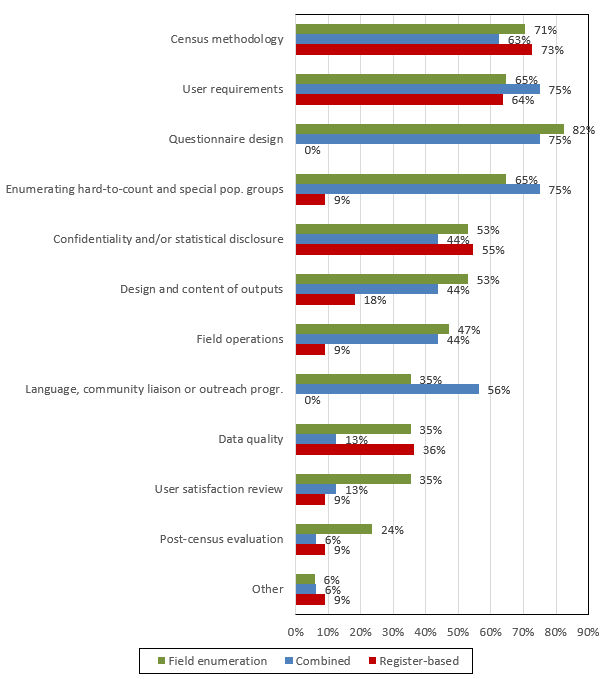
122. The NSOs, in the consultations and communications with data users and other stakeholders, were discussing various census aspects, with significant differences depending on the type of census (Figure 2).
123.
123. Census methodology and user requirements were among the census aspects most discussed (in about two thirds of the countries) regardless of the census methods. Other census aspects associated with the field enumeration, like questionnaire design or enumerating hard-to-reach population groups, were discussed by many countries with field enumeration or combined census, but not for register-based censuses, as expected.
124.
124. Confidentiality and statistical disclosure were discussed in about half the countries, regardless of the type of census. Data quality is discussed in about one third of the countries with field enumeration and register-based censuses, but only in 13% of the countries with combined census (2 out of 16 countries).
Figure 2
Census aspects discussed with users and stakeholders
Census aspects discussed with users and stakeholders
 5.5 Publicity campaign
125.
125. A campaign for census publicity or public information was carried out in the 2020 round in all countries that conducted a field enumeration or combined census (with the exception of Switzerland) and in only two of the countries with a register-based census: Latvia and Lithuania (Table 21).
126.
126. In countries with field enumeration or combined census, the campaign was covering the collection phase in almost all countries, the dissemination phase in about two thirds of the countries, and the consultation in about one third. The campaign covered also the census preparations in Slovakia, the pilot census in the Republic of Moldova, and the field staff recruitment in Portugal. In Latvia and Lithuania, the campaign covered only the dissemination phase.
127.
127. In countries with field enumeration or combined census, the campaign was covering the collection phase in almost all countries, the dissemination phase in about two thirds of the countries, and the consultation in about one third. The campaign covered also the census preparations in Slovakia, the pilot census in the Republic of Moldova, and the field staff recruitment in Portugal. In Latvia and Lithuania, the campaign covered only the dissemination phase.
Table 21 Publicity or public information campaign (number of countries)
|
Total
(out of 49 countries) |
Type of census
|
|||
|
Field enumeration (17 countries)
|
Combined
(18 countries) |
Register-based
(14 countries) |
||
|
Publicity campaign undertaken
|
36
|
17
|
17
|
2
|
|
For consultation phase
|
13
|
6
|
7
|
-
|
|
For collection phase
|
32
|
17
|
15
|
-
|
|
For dissemination phase
|
27
|
12
|
13
|
2
|
|
For other census phases/aspects
|
3
|
1
|
2
|
-
|
|
No publicity campaign
|
13
|
0
|
1
|
12
|
128.
128. Information was collected in the survey also on what percentage of the communications and publicity budget was directed towards each of the census phases. Among countries with field enumeration or combined census, the majority of the budget (the total budget, in Armenia, Cyprus, France and Israel) was spent for the collection phase, with a few exceptions. In Italy and North Macedonia, 70% of the budget was spent for the consultation and only 10 and 20%, respectively, was spent for the collection. In Bulgaria, the Russian Federation and Turkmenistan, half of the budget was spent for collection, with the remaining budget spent mostly for consultation in the Russian Federation, for dissemination in Turkmenistan, and equally divided between the two phases in Bulgaria.
129.
129. The countries that spent most for dissemination are Latvia and Lithuania (100% of the publicity budget for their register-based censuses), Turkmenistan (50%) and Kazakhstan (40%). Eleven countries out of the 36 that conducted a publicity campaign spent 10% or less on the dissemination phase.
130.
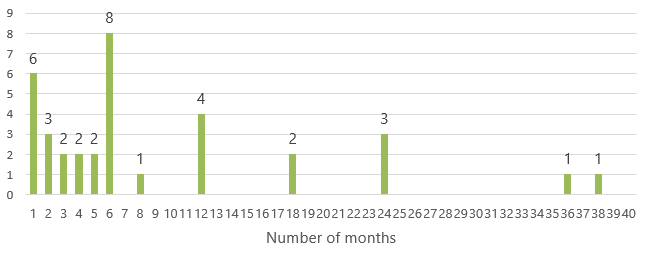
130. When asked how far in advance of census collection countries began informing their populations, the results were surprising (Figure 3). Most countries initiated this process six months prior to collection. However, the range varied significantly, from one month to as much as 38 months. It raises the question of whether some countries may have included their census test communications in these figures. Regardless, creating early awareness is important as it may increase social acceptability of government data collection and trust in public institutions for both field and register based countries.
Figure 3
Time between the start of the census information campaign and the start of census collection (number of countries)
Time between the start of the census information campaign and the start of census collection (number of countries)
131.
131. The aims of the publicity campaign were quite similar across different countries, with the following aims reported by most countries: engaging (34 countries), explaining (33), educating (31) and encouraging (28) their populations about census.
132.
132. In countries with field enumeration or combined census, the method to publicize or promote the census reported by most countries are national TV (26 countries), paid advertising (16), national radio (12), billboards (10) and press conferences (10). Internet and social media were used in total by 26 countries, but in different ways: using search engine marketing (11 countries), paid or unpaid influencers (11), or streaming platforms (8).
133.
133. The target groups for the communication and publicity campaign are diverse. However, the results indicate that the five most popular are families, young adults, specific ethnic and racial communities, older individuals and people with visual or hearing impairments or other disabilities. Media, website visitors and rural communities were also mentioned as target groups.
134.
134. Thirty-five per cent (35%) of countries reported that they did not have any harder-to-enumerate groups among their key target groups for the communication and publicity campaign. Twenty nine per cent (29%) of countries acknowledged the presence of such groups, and 23% developed specific strategies to reach them. In countries with field enumeration or combined census, strategies were often developed to reach these harder-to-enumerate groups. Conversely, countries that rely on register or sample-based methodologies are less likely to do so.
135.
135. The list of harder-to-enumerate groups includes apartment dwellers and renters, rural communities, specific ethnic/racial communities, the LGBTQ+ community, single foreign households, the homeless population, students living away from home, people temporarily abroad during the census, immigrants, parents of young children, young men, owners of holiday homes and vacant properties, people with disabilities, indigenous people in remote areas, urban populations, young adults, younger singles and couples, and retired singles and couples.
136.
136. Strategies developed to reach these harder-to-enumerate groups include engaging with the media, consulting with groups or organizations that represent these populations, involving NGOs and community-based organizations, launching targeted paid media campaigns, conducting targeted outreach campaigns, and creating tailored and translated communication messages and materials that are culturally relevant and sensitive.
5.6 Social media
137.
137. The use of social media for the census was reported by all countries, except for Sweden and Norway, where the census is only a project for delivering data to international organizations. According to the survey results (Table 22), social media appears to be particularly popular for the dissemination (36 countries) and collection phases (30) and less so for the consultation phase (12 countries). Georgia reported using social media for their advertising campaigns prior to data collection. In countries with register-based census, social media were used only in the dissemination phase.
Table 22
Use of social media (number of countries)
Use of social media (number of countries)
|
Total
(out of 43 countries) |
Type of census
|
|||
|
Field enumeration (15 countries)
|
Combined
(16 countries) |
Register-based
(12 countries) |
||
|
Social media were used
|
41
|
15
|
16
|
10
|
|
For consultation phase
|
12
|
6
|
6
|
0
|
|
For collection phase
|
30
|
15
|
14
|
1
|
|
For dissemination phase
|
36
|
11
|
15
|
10
|
|
Social media were NOT used
|
2
|
0
|
0
|
2
|
138.
138. The criteria most used to select social media platforms was to choose the platforms most used in the country (indicated by 30 out of 42 reporting countries), followed by considering target audience or user demographics (25), current trends (19) and characteristics of platforms (15). Some countries mentioned that they simply used the standard tools available in their organization.
139.
139. The primary purpose of using social media was to disseminate information (indicated by 37 out of 41 responding countries), followed by publicizing census activities (31), engaging the population (27), answering questions (21) and monitoring public sentiment about the census (12).
140.
140. Finally, in order to monitor their social media channels, 28 countries (out of 38 reporting) used dedicated individuals or teams, 17 countries used monitoring tools and 11 countries outsourced monitoring to an external company. Six countries did not monitor their social media activity.
141.
141. Detailed information on the use of social media collected in the UNECE survey is available in the Communication section of the UNECE 2020 Census Round dashboard.