





Chapter 1 Census methods

Detailed information collected in the UNECE survey on the census methodology adopted by countries in the 2020 round is available in the Methodology section of the UNECE 2020 Census Round dashboard.
1.
1. This chapter presents a review of the different methodologies for carrying out the census adopted by countries in the UNECE region in the 2020 round1 (covering the period 2015–2024), and draws attention to significant changes compared to the 2010 census round.
 1.1 Where and when were censuses taken
2.
2. As part of the 2020 round, between 2015 and 2024, 52 out of the 56 countries in the UNECE region (93%) carried out a census in one form or another. Of these, 9 countries carried out more than one census (Canada, France, Liechtenstein, Ireland, Italy, Monaco, Slovenia, Spain, Switzerland). Italy and Switzerland conduct a census every year. Bosnia and Herzegovina, San Marino, Ukraine and Uzbekistan did not carry out a census as part of the 2020 round.
3.
3. Concerning the year when the census was taken, most countries (33) took a census in 2021 (Table 1). This concentration was greatly influenced by the European Union (EU) legislation designating 2021 as the reference year for the census data to be transmitted to Eurostat. Among EU member states, only four did not take their censuses in that year. France carried out its census in 2020, while Ireland, Germany and Hungary conducted theirs in 2022. In the United Kingdom, the census was held in 2021 in England and Wales, and in Northern Ireland, and in 2022 in Scotland.
4.
4. Among other UNECE member countries, Azerbaijan and Belarus carried out their censuses in 2019, three countries in 2020 (Liechtenstein, Tajikistan and the United States), three countries in 2023 (Albania, Monaco and Montenegro) and two countries in 2024 (Georgia and the Republic of Moldova).
Table 1
Population censuses of the 2020 round in the UNECE region, by type and reference date
Population censuses of the 2020 round in the UNECE region, by type and reference date
|
Year
|
Reference date
|
Country
|
Type of census
|
|
2019
|
01 October 2019
|
Azerbaijan
|
Full field enumeration without using register information
|
|
04 October 2019
|
Belarus
|
Combined (registers + complete field data collection)
|
|
|
2020
|
01 January 2020
|
France
|
Rolling census
|
|
01 April 2020
|
United States of America
|
Traditional enumeration with yearly updates
|
|
|
01October 2020
|
Tajikistan
|
Full field enumeration without using register information
|
|
|
31 December 2020
|
Liechtenstein
|
Combined (registers + complete field data collection)
|
|
|
2021
|
01 January 2021
|
Andorra #
|
Combined (registers + census-specific survey(s))
|
|
01 January 2021
|
Belgium
|
Register-based (+ data from survey(s))
|
|
|
01 January 2021
|
Denmark
|
Register-based
|
|
|
01 January 2021
|
Finland
|
Register-based
|
|
|
01 January 2021
|
Iceland
|
Register-based
|
|
|
01 January 2021
|
Latvia
|
Register-based
|
|
|
01 January 2021
|
Lithuania
|
Register-based
|
|
|
01 January 2021
|
Netherlands (Kingdom of the)
|
Register-based (+ data from survey(s))
|
|
|
01 January 2021
|
Norway
|
Register-based
|
|
|
01 January 2021
|
Slovakia
|
Combined (registers + complete field data collection)
|
|
|
01 January 2021
|
Slovenia
|
Register-based
|
|
|
01 January 2021
|
Spain
|
Register-based
|
|
|
21 March 2021
|
United Kingdom (Scotland: 20 March 2022)
|
Full field enumeration supported by register data
|
|
|
26 March 2021
|
Czechia
|
Combined (registers + complete field data collection)
|
|
|
31 March 2021
|
Poland
|
Combined (registers + complete field data collection)
|
|
|
19 April 2021
|
Portugal
|
Full field enumeration supported by register data
|
|
|
11 May 2021
|
Canada
|
Full field enumeration supported by register data
|
|
|
31 August 2021
|
Croatia
|
Full field enumeration supported by register data
|
|
|
01 September 2021
|
Kazakhstan
|
Full field enumeration supported by register data
|
|
|
04 September 2021
|
North Macedonia
|
Combined (registers + complete field data collection)
|
|
|
07 September2021
|
Bulgaria
|
Full field enumeration supported by register data
|
|
|
01 October 2021
|
Cyprus
|
Combined (registers + census-specific survey(s))
|
|
|
01 October 2021
|
Russian Federation
|
Full field enumeration without using register information
|
|
|
03 October 2021
|
Italy
|
Combined (registers + census-specific survey(s))
|
|
|
22 October 2021
|
Greece
|
Full field enumeration without using register information
|
|
|
31 October 2021
|
Austria
|
Register-based
|
|
|
08 November 2021
|
Luxembourg
|
Combined (registers + complete field data collection)
|
|
|
21 November 2021
|
Malta
|
Full field enumeration supported by register data
|
|
|
01 December 2021
|
Romania
|
Full field enumeration without using register information
|
|
|
31 December 2021
|
Estonia
|
Combined (registers + census-specific survey(s))
|
|
|
31 December 2021
|
Sweden
|
Register-based
|
|
|
31 December 2021
|
Switzerland
|
Combined (registers + census-specific survey(s))
|
|
|
31 December 2021
|
Türkiye
|
Register-based (+ data from survey(s))
|
|
|
2022
|
25 March 2022
|
Kyrgyzstan
|
Full field enumeration without using register information
|
|
02 April 2022
|
Israel
|
Combined (registers + census-specific survey(s))
|
|
|
03 April 2022
|
Ireland
|
Combined (registers + complete field data collection)
|
|
|
15 May 2022
|
Germany
|
Combined (registers + census-specific survey(s))
|
|
|
30 September 2022
|
Serbia
|
Combined (registers + complete field data collection)
|
|
|
01 October 2022
|
Hungary
|
Combined (registers + complete field data collection)
|
|
|
13 October 2022
|
Armenia
|
Combined (registers + census-specific survey(s))
|
|
|
17 December 2022
|
Turkmenistan
|
Full field enumeration without using register information
|
|
|
2023
|
18 September 2023
|
Albania
|
Full field enumeration without using register information
|
|
30 November 2023
|
Montenegro
|
Full field enumeration without using register information
|
|
|
31 December 2023
|
Monaco
|
Register-based
|
|
|
2024
|
08 April 2024
|
Republic of Moldova
|
Combined (registers + complete field data collection)
|
|
14 November 2024
|
Georgia
|
Full field enumeration supported by register data
|
# Sources for Andorra: census date from United Nations Statistics Division; type of census from Department of Statistics of Andorra. No other information on the census of Andorra was collected with the UNECE survey.
1.2 How were censuses taken – methodological approaches
5.
5. Approaches to conducting a population census have evolved over time. In the earliest European censuses they were just statistical summaries; later they became lists where each enumerated person was recorded in a separate line (within his own household); they then evolved to become individual forms where information was recorded separately for each individual or household. More recently, countries have increasingly looked to make use of data collected through registers or administrative data. While methodologies have become more varied, the statistical objective remains the same.
6.
6. Techniques of enumeration have also evolved. Information was historically collected using paper forms with the delivery and collection of the forms done by census enumerators, but in more recent times mail delivery and/or collection was adopted in several countries. Also, in many countries there was a transition from the compilation of forms through enumerators to self-enumeration by the respondents. A further transition was the use of electronic questionnaires as an alternative collection mode to paper questionnaires.
7.
7. The use of population and other registers, alone or in combination with administrative data and/or surveys, is now at the centre of most changes in census methods. If Nordic countries started already in the 1970s to move from the “traditional” census to a register-based approach (with Denmark conducting a fully register-based census in 1981, followed by Finland in 1991), the use of registers does not always allow the production of census data without making recourse to field operations. In several UNECE countries, population registers do exist, but their coverage and quality are not always sufficient to ensure the quality required by census data, while registers covering other social and demographic characteristics also exist, but do not cover all census topics.
8.
8. Where population registers do not exist, countries have increasingly looked to make use of data which is a by-product of administrative processes such as for taxation. In some cases, the motivation for change was to overcome organizational problems or opposition to traditional censuses from the public opinion where the traditional census was perceived as being too intrusive. In other cases, the primary motivation was to reduce costs (by, for example, taking advantage of the information already available in the registers or other data sources), or the desire to produce census data more frequently than every ten years, such as on an annual or even a continuous basis. More often, the interest in developing new approaches to census taking was in response to a combination of these reasons.
9.
9. Another important methodological change for some countries has been the use of sampling to replace the full-field enumeration of selected census variables (including for the census count, as for the French rolling census).
10.
10. For these reasons, many countries have developed combined systems, making use of the information available in registers and administrative sources to complement information collected through field operations (e.g. in order to ensure the exhaustivity of the count) or, the opposite, making use of ad hoc field surveys to complement information available in the registers. In some cases, the population count is fully register-based while census variables are produced using a combination of register data and survey data. In some others, both the population count and the census variables are produced by the combination of registers and surveys.
11.
11. As a result of the development of these new methodologies, the classification of countries according to the approach used for carrying out the census becomes ever more complicated. However, for the purposes of this report, and in order to allow comparison with the previous round, three broad categories for summarising different census approaches have been used: full field enumeration (corresponding to the previous round category ”traditional”), register-based and combined, though this represents only one of several possible classifications.
12.
12. The definition of the three categories and the subsequent inclusion of each country in one or the other is not straightforward. For example, countries using data from sample surveys that are not conducted specifically for the census could also be considered as conducting a combined census, but in this classification they have been grouped together with fully register-based censuses, as these field data generally amount to only a very small proportion of the total population information for each country.
Table 2 UNECE countries by census method used in the 2020 round
|
Census methodology
|
Number of countries
|
Countries
|
|
Field enumeration censuses
|
19
|
|
|
Full field enumeration without using register information
|
9
|
Albania, Azerbaijan, Greece, Kyrgyzstan, Montenegro, Romania, Russian Federation, Tajikistan, Turkmenistan
|
|
Full field enumeration supported by register information used only as frame or control
|
8
|
Bulgaria, Canada. Croatia, Georgia. Kazakhstan, Malta, Portugal, United Kingdom
|
|
Rolling census (cumulative continuous survey)
|
1
|
France
|
|
Traditional enumeration with yearly updates of characteristics on a sample basis
|
1
|
United States of America
|
|
Combined censuses
|
19
|
|
|
Combination of register data with census-specific sample field data collection
|
8
|
Andorra, Armenia, Cyprus, Estonia, Germany, Israel, Italy, Switzerland
|
|
Combination of register data with complete field data collection
|
11
|
Belarus, Czechia, Hungary, Ireland, Liechtenstein, Luxembourg, North Macedonia, Poland, Republic of Moldova, Serbia, Slovakia
|
|
Register-based censuses
|
14
|
|
|
Fully register-based
|
11
|
Austria, Denmark, Finland, Iceland, Latvia, Lithuania, Monaco, Norway, Slovenia, Spain, Sweden
|
|
Register-based using data from existing sample survey(s)
|
3
|
Belgium, Netherlands (Kingdom of the), Türkiye
|
13.
13. In addition, the “combined” category includes many census approaches quite different from one another, for example, countries conducting a full-field enumeration and countries producing a fully register-based count, or countries conducting a census every year and countries conducting a five-yearly or decennial census. Finally, also the “full field enumeration” category includes several quite distinctive approaches. The rolling census of France – based on annual surveys carried out on rotation basis in the various municipalities and aggregation of the results over five years – could be considered as a separate methodology, as well as the census of the United States of America where the decennial count is supplemented with an annual sample survey (the American Community Survey, ACS). They both comply with the general criterion identifying the category as they are based on field data collection and not making recourse to register data for producing census data.
14.
14. Despite this complexity, the classification into the three broad categories of full field enumeration, register-based and combined remains useful for describing the main features of the different census exercises (Table 2) .
15.
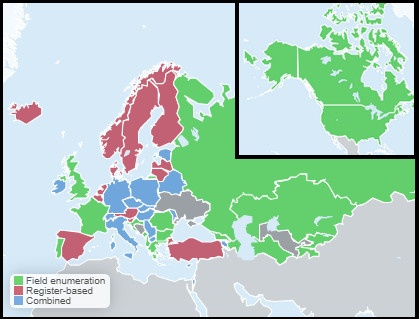
15. The increased diversity of population census methods is well represented by their geographic distribution (see Figure 1). Register-based censuses, once conducted mainly by the Nordic countries and selected countries in Central Europe, were conducted in the 2020 round as south as Spain and as east as Türkiye; whereas many of countries have adopted combined approaches, and an almost equally wide range of countries fully relied on field enumeration in their census.
Figure 1
UNECE countries by type of population census in the 2020 round
UNECE countries by type of population census in the 2020 round
Source: UNECE Wiki page “Censuses of the 2020 round”
Table 3
UNECE countries by population census method used in the 2010 and 2020 rounds
UNECE countries by population census method used in the 2010 and 2020 rounds
|
Census method in the 2010 round
|
Census method in the 2020 round
|
Total 2010 round
|
|||
|
Field enumeration
|
Combined
|
Register-based
|
No census
|
||
|
Field enumeration (traditional)
|
Albania
Azerbaijan
Bulgaria
Canada
Croatia
France
Georgia
Greece
Kazakhstan
Kyrgyzstan
Malta
Montenegro
Portugal
Romania
Russian Federation
Tajikistan
Turkmenistan
United Kingdom
United States of America
|
Andorra
Armenia
Belarus
Cyprus
Czechia
Hungary
Ireland
Italy
Luxembourg
North Macedonia
Republic of Moldova
Serbia
Slovakia
|
Monaco
|
Bosnia and Herzegovina
San Marino
|
35
|
|
Combined
|
Estonia
Germany
Israel
Liechtenstein
Poland
Switzerland
|
Latvia
Lithuania
Spain
Türkiye *
|
10
|
||
|
Register-based
|
Austria
Belgium #*
Denmark
Finland
Iceland #
Netherlands #*
Norway
Slovenia
Sweden
|
9
|
|||
|
No census
|
Ukraine
Uzbekistan
|
2
|
|||
|
Total 2020 round
|
19
|
19
|
14
|
4
|
|
Source: UNECE census surveys (2010 and 2023), information available at UNECE.
Countries that changed method between 2010 and 2020 census rounds
# Register-based census using data from existing sample survey(s) in the 2010 round
* Register-based census using data from existing sample survey(s) in the 2020 round
16.
16. The trend towards the use of register-based and combined census has continued in the 2020 round (see Table 3). Five more countries (Monaco, Latvia, Lithuania, Spain and Türkiye) have joined the “register-based census” group that grew from 9 countries in the 2010 round to 14 countries in the 2020 round, whereas 13 countries changed from a field enumeration census in the 2010 round to a combined census in the 2020 round. As a result, the number of countries conducting a combined census nearly doubled from 10 in the 2010 round to 19 in the 2020 round, bringing it to the same number of countries conducting a census entirely based on full field enumeration. Overall, the number of countries making recourse to the use of registers for producing census data, either fully or in a combined design, increased from 19 to 33.
17.
17. While the large majority of countries adopted the same methodological approach for the population census and the housing census, some UNECE countries reported that they used different methods. More information on this is provided in section 23.2.
1.3 Field enumeration censuses
18.
18. With the use of new technologies and data-collection methodologies, and the availability of a multitude of data sources, the term “traditional” used so far to designate censuses based on full field enumeration no longer reflects census-taking in the UNECE region. The term field enumeration census is therefore used to designate a census where information on individuals and housing units is collected in the field or provided directly by individuals through a full field enumeration – whether supported by register information used as a frame or for control or not, whether by means of a doorstep interview of household members, or through self-completion of the questionnaire, whether using a paper or an electronic questionnaire or providing the information by telephone. The basic census characteristics on all individuals and housing units are normally collected at a specific point in time by using a unique questionnaire or on a sample basis through the use of long and short forms, but sometimes more detailed characteristics are collected by pooling data from rolling samples over years.
19.
19. On this basis, the quite different methodologies adopted in the censuses in the United States (field enumeration with short form plus annual updates based on sample surveys) and Canada (field enumeration with short form plus voluntary sample survey) as well as the rolling census of France satisfy the most essential criterion of collecting information directly from the data subject without recourse to the use of registers or other data sources.
20.
20. Table 3 shows that one third of countries in the UNECE region (19) conducted a full field enumeration in the 2020 round whereas two thirds had done so in the 2010 round. Countries in the UNECE region that moved from a full field enumeration to a combined approach in the 2020 round include Andorra, Armenia, Belarus, Cyprus, Czechia, Hungary, Ireland, Italy, Luxembourg, North Macedonia, Republic of Moldova, Serbia and Slovakia, while Monaco moved straight from full field enumeration in 2016 to a fully register-based census in 2023.
21.
21. Among the countries that conducted a full field enumeration in the 2020 round, the number of countries that conducted field enumerations using the support of registers as frame or control is almost the same as the number of countries that did not use register information at all (8 versus 9). This is significantly different from the 2010 round, when only one third of the countries used the support of registers.
22.
22. The United States conducted its 2020 census with a complete enumeration collecting limited demographic data only, supplemented with data on the full range of census topics (on a sample basis only) from the American Community Survey (first fully implemented in 2005), while France carries out a rolling census in which a moving sample of the population is enumerated each year, such that the whole country is covered at least once within a five year period.
23.
23. The survey results also show that among the 19 countries that conducted a full field enumeration, differently from the 2010 round, the most commonly adopted enumeration method was the online self-enumeration, used in 12 countries, followed by the computer-assisted personal interview (CAPI) used by 8 countries.
1.4 The register-based approach
24.
24. In the 2020 round, 14 countries (up from 9 in the 2010 round) carried out their census using a primarily register-based approach (Austria, Belgium, Denmark, Finland, Iceland, Latvia, Lithuania, Monaco, Netherlands (Kingdom of the), Norway, Slovenia, Spain, Sweden and Türkiye). Eleven (11) countries (6 in the previous round) used only data linked together from administrative registers to create the population and demographic variables, while 3 countries (Belgium, Netherlands (Kingdom of the) and Türkiye) also used data from pre-existing sample surveys to produce census variables that are either missing or cannot be accessed from registers. These data amounted to only a very small proportion (2% or less) of the total variables for Belgium and the Kingdom of the Netherlands, while for Türkiye 40% of the information was collected through computer-assisted telephone interviews (CATI). All the countries with a register-based census the information relating to housing entirely from registers, except for Türkiye that used sample survey data for this.
25.
25. A discussion of the various registers used as data sources for the census in countries using either a register-based or combined approach is presented in section 1.6 below.
1.5 The combined methodology approach
26.
26. Nineteen (19) UNECE countries, that is over one third of the number of countries conducting a census in the 2020 round, adopted a ”combined” methodological approach, whereby some information was taken from registers while other information was collected through a field operation, either with ad hoc sample surveys or with a complete field data collection. Seven (7) countries adopted the first of these two approaches while 11 adopted the second (see Table 4).
27.
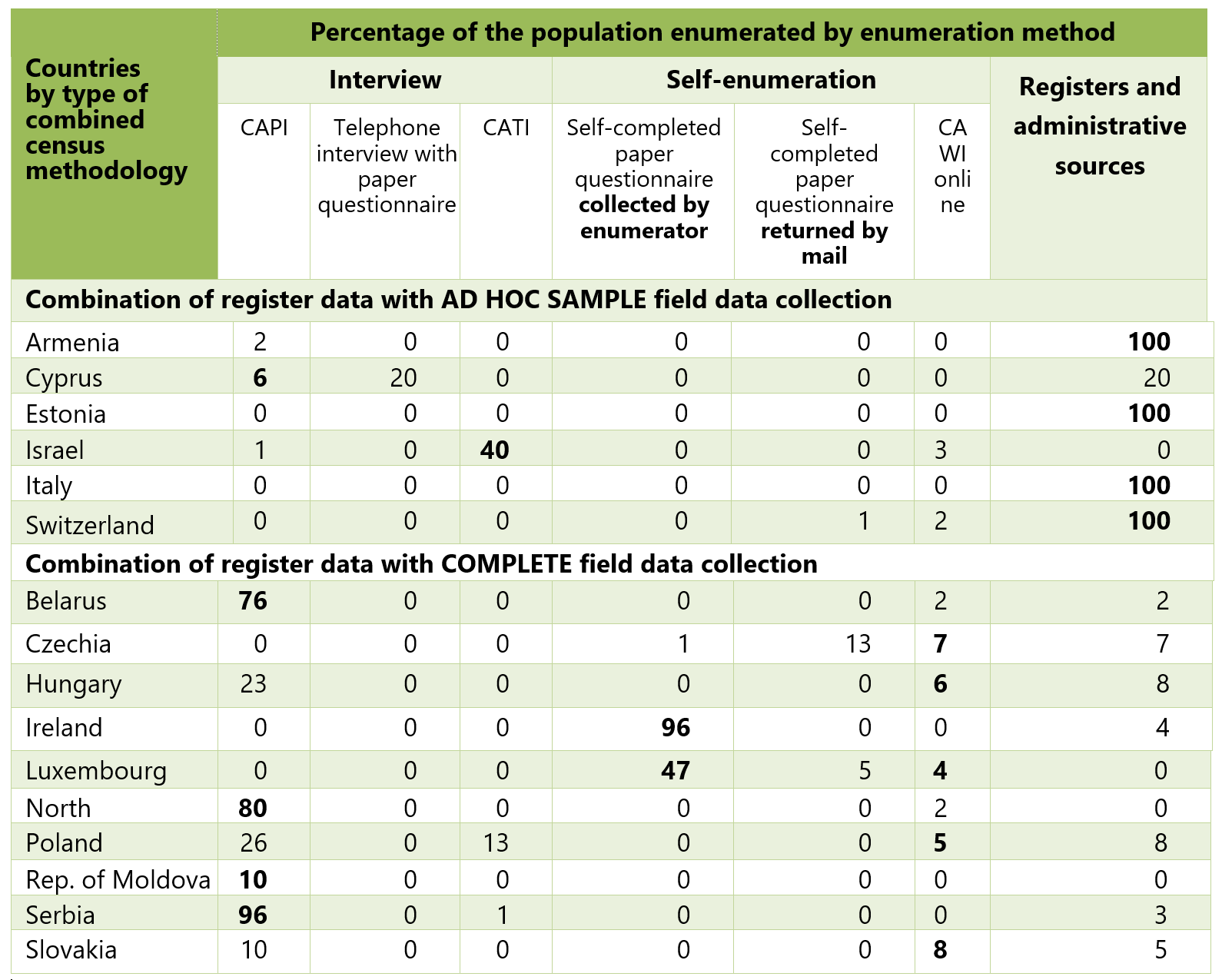
27. The UNECE survey included two questions, in order to distinguish between the methods used for enumerating the population and those used for census variables. Concerning the population count, two countries (Estonia and Italy) conducted a fully register-based count while the Republic of Moldova used the count obtained through field enumeration. The rest of the countries with the combined approach used both sources for the population count. Some countries conducted a complete field data collection and used registers or administrative sources to complete the count or impute the population missed by the field enumeration. The scale of such correction ranges from 8% in Hungary and Poland to 2% in Belarus.
Table 4 Percentage of the population enumerated by enumeration method for countries with a combined census
Note: Information not available for Andorra, Germany and Lichtenstein.
28.
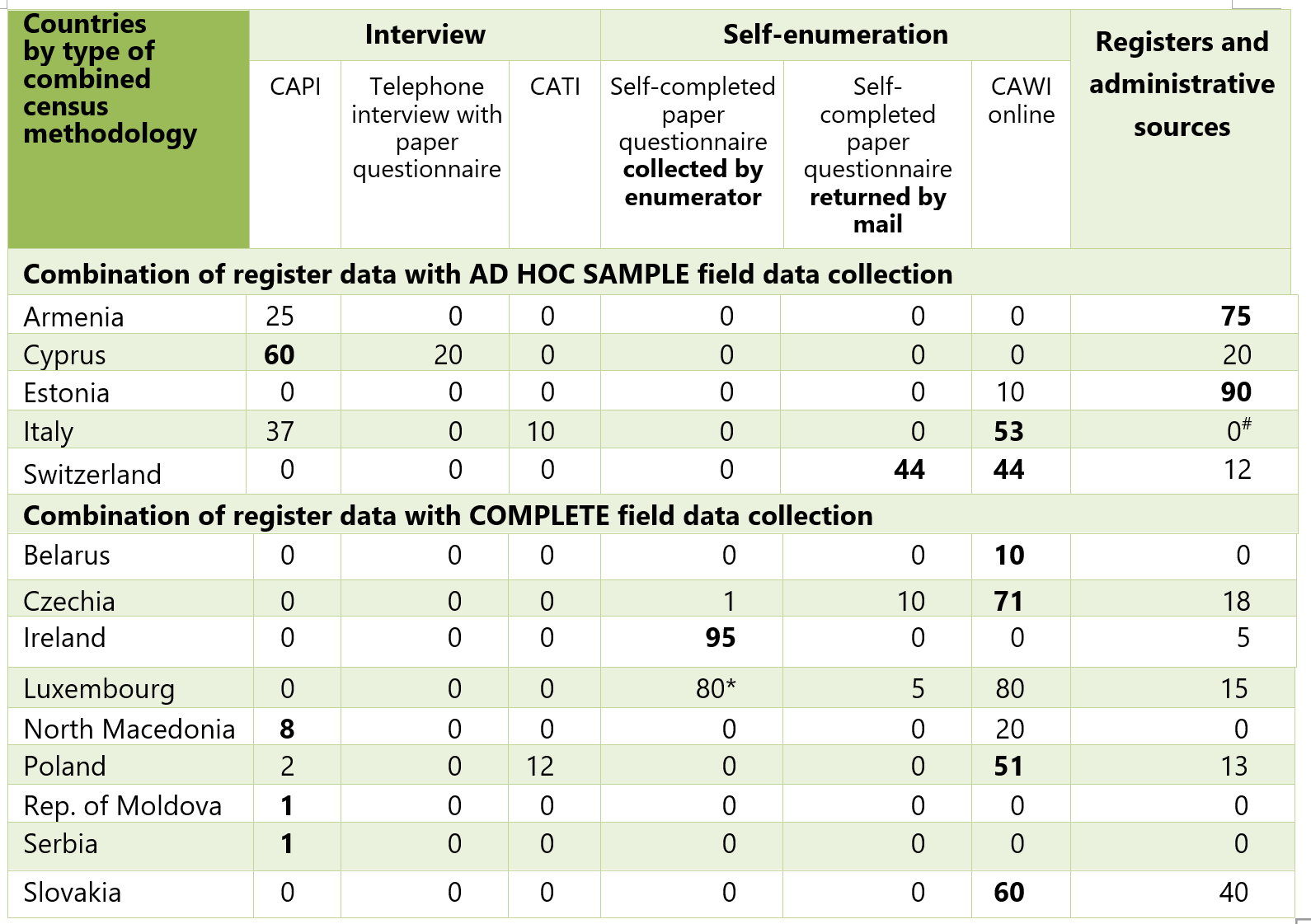
28. Concerning the percentage of census variables collected or produced with each census method, here again the answers to the survey show a wide range of census designs (Table 5). In some cases registers are used for producing a share of census variables for the whole population (e.g. the 15% of variables in Luxembourg, where registers where not used at all for the population count). Differently from the population count, no country derived census variables entirely from registers whereas four countries derive them from field enumeration entirely (Belarus, North Macedonia, Republic of Moldova and Serbia) or almost entirely (95% in Ireland). At the other extreme, Estonia and Armenia derive respectively 90% and 75% of the census variables from registers and administrative sources, while Slovakia uses registers for 40%, and Luxembourg, Poland and Switzerland for 15%, 13% and 12% of the variables, respectively. Moreover, in some cases both registers and survey data are used for the same variables, as is the case for Italy, where only four variables (sex, age, citizenship and place of birth) are entirely derived from registers and all the remaining variables are produced through model-based estimates combining information from registers and two sample surveys conducted yearly.
Table 5 Percentage of census variables collected/produced by enumeration method for countries with a combined census
Notes:
Information not available for Andorra, Germany, Hungary, Israel and Lichtenstein.
Information not available for Andorra, Germany, Hungary, Israel and Lichtenstein.
# Italy: only four variables (sex, age, citizenship and place of birth) are entirely derived from registers.
* Luxembourg: not possible to make the distinction between paper questionnaire and online questionnaire (CAWI)
1.6 The scope of registers used
29.
29. When analysing census approaches, a clearer distinction needs to be made between data from population registers and administrative data. Population registers require individuals to notify the state of current residence, whereas administrative data sources hold information about individuals as a by-product of an administrative process, e.g. tax or healthcare. For historical and cultural reasons, population registers would not be publicly acceptable in some countries whereas administrative data is widely available across all countries. Regardless of the source, there must be strong security, legal and ethical controls over the use of individual data.
30.
30. Clearly, administrative data play a vital role in census taking, even in those countries conducting a full field enumeration. The majority of countries use administrative data in one way or another in connection with the census. Uses range from supporting census activities, especially when establishing address-lists, to complementing census data or verifying/controlling the quality of the collected data and, of course, to providing the actual census database itself. As well as reporting on the extent to which registers were used to provide census data, countries also identified in the survey the different types of registers used (Table 6).
31.
31. All the register-based countries (14 in total) used the population register, suggesting that such a register is the minimum prerequisite for any country wishing to undertake a fully register-based census and, indeed, this data source was used more than any other type of register even among countries adopting a combined approach.
32.
32. All the 14 countries with a register-based census employed a range of register and/or administrative data. In addition to the population register – vital for providing basic demographic data – all of these countries used the education data and most of them data relating to buildings, employment, social security, tax, addresses and the business register. Six (6) of the countries reported using all the data sources specifically identified in the survey, while 7 countries reported the use of additional registers (among these, the most frequently reported were unemployment register, students register and foreign population register).
Table 6
Number of countries using registers in register-based or combined censuses, by type of registers
Number of countries using registers in register-based or combined censuses, by type of registers
|
Type of register
|
Type of census
|
|
|
Combined census
|
Register based census
|
|
|
Total countries using registers
|
18
|
14
|
|
Population register
|
15
|
14
|
|
Education register
|
11
|
14
|
|
Building register
|
9
|
13
|
|
Employment register
|
11
|
12
|
|
Social security register
|
14
|
10
|
|
Tax register
|
8
|
10
|
|
Address register
|
13
|
9
|
|
Business register
|
5
|
8
|
|
Other registers
|
6
|
7
|
33.
33. Countries conducting combined censuses appear to use a wide range of administrative sources as well. In fact, the proportion of countries making use of each of those registers to the total number of countries in the group is high, similar to register-based countries (Table 6). Furthermore, several other sources besides those specifically identified in the survey were mentioned (such as database of operators of public telecommunication networks/distributors of electric energy, health insurance registers), suggesting that the real issue in order for the registers to provide an acceptable alternative to data collected directly from individuals is probably not the existence of the administrative data, but rather their content, especially in terms of coverage and quality.
34.
34. Other barriers to the use of administrative data are likely to include the lack of standardisation among different data sources, particularly where they are not managed by the national statistical office, technical or legal problems in accessing or linking data, presence of a limited number of variables and, not least, deep-rooted political or public opposition.
35.
35. Indeed, even countries producing low percentages of their census information through administrative data, report using many different sources (e.g. Ireland reported the use of 5 sources even though only 5% of the census variables were produced using administrative data). Interestingly, Estonia that in the 2010 round had reported collecting just 1% of its census information through registers (and using 6 different sources), in the 2020 round has collected 90% of the census variables through administrative data, using all the sources specifically identified in the questionnaire.